


One of Latin America and the Caribbean’s biggest opportunities in the AI value chain lies in combining global models with local data, talent and expertise to solve practical problems.
Last updated: 7/11/2026
The AI value chain spans specialized semiconductors, computing infrastructure, data acquisition, preparation and management, foundation models, software and integration tools, and the development and deployment of applications. These stages differ substantially in their barriers to entry, market concentration and opportunities for creating value.
The AI value chain and opportunities for value creation in Latin America and the Caribbean
The percentages show each stage’s share of the estimated market value of the global AI value chain.
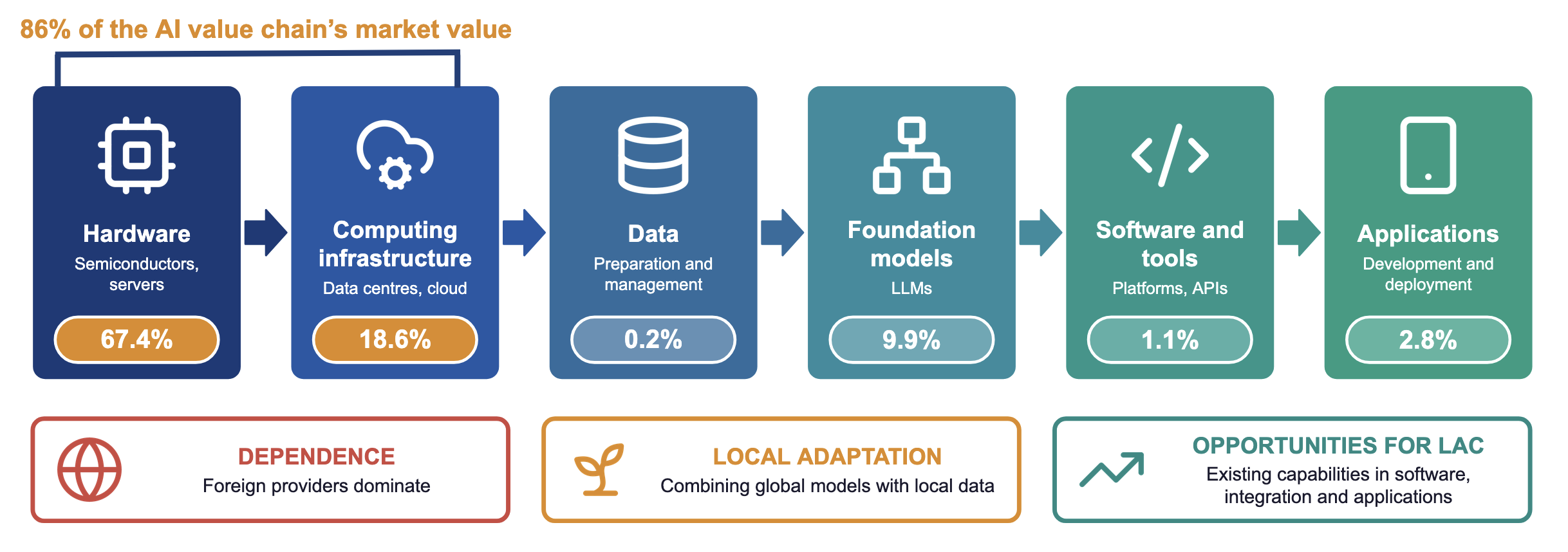
Fuente: Author’s own elaboration based on Katz and Callorda (2026).
The upstream stages of the value chain have the highest barriers to entry and are highly concentrated globally. ILIA 2026 reports that NVIDIA accounts for more than 80% of the AI chip market, while Amazon Web Services (AWS), Microsoft Azure and Google Cloud together accounted for around 68% of the global market for infrastructure as a service (IaaS) and platform as a service (PaaS) in 2025. The report also estimates that fewer than ten organizations worldwide have the capacity to develop frontier models on an ongoing basis.
For Latin America and the Caribbean, this concentration makes it harder to compete on equal terms in some of the segments that depend most heavily on capital, infrastructure and intellectual property.
Software, integration and applications offer a different set of opportunities. Fixed costs are lower, and capabilities that can be developed locally carry greater weight. These include access to data, engineering expertise, knowledge of production processes and sector-specific expertise. Realizing these opportunities requires high-capacity, low-latency connectivity and reliable access to computing resources.
The region can create value by adapting AI tools and integrating them with its own assets. A model developed for global use can become more valuable when combined with local data, business rules and specialist knowledge in areas such as health, agriculture, manufacturing, finance and logistics.
Specialized business ecosystems can strengthen these capabilities by connecting companies with universities, research centres, skilled professionals, sources of finance and businesses that use AI. The number of AI companies gives an indication of the ecosystem’s size. Its contribution depends on how effectively those companies turn knowledge and technology into solutions to concrete economic and social problems.
Even when these activities create value, some of it can flow to external providers of infrastructure, models or platforms. Interoperability, data portability and the ability to audit systems and switch providers shape how much room local companies have to innovate and how much of the value they create they can retain.
A viable strategy for Latin America and the Caribbean is to strengthen the critical assets that enable access to global technology while building its own capabilities in selected segments. Local data, sector expertise, skilled professionals and specialized business ecosystems can give the region a competitive advantage in developing and deploying solutions suited to its needs.
More data and facts
Connected economy
Digital economy
Indicators list
Related SDG
