


Brazil accounts for more than half of the AI tools and companies identified, but Uruguay, with the smallest total of the five countries, ranks first both per capita and per business.
Last updated: 11/11/2026
The supply-side AI ecosystems of Brazil, Chile, Colombia, Mexico and Uruguay differ considerably in size. The study identifies 4,585 AI tools and companies, associated with 4,521 distinct companies, offering AI products or services to external customers across the five countries analysed.
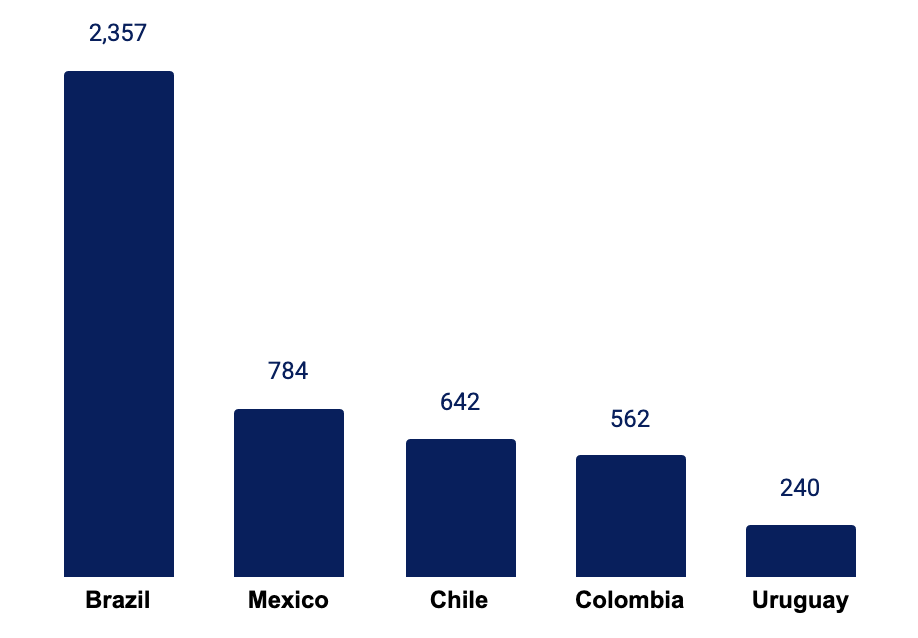
In absolute terms, Brazil clearly has the largest identified supplier base, with 2,357 AI tools and companies, just over half of the total. Mexico follows with 784, Chile with 642, Colombia with 562 and Uruguay with 240.
AI tools and companies identified in five Latin American countries
Source: Own elaboration based on data from RankMyAI.
These figures capture the scale of the domestic AI supplier base, but they are strongly influenced by differences in country size. When the number of AI tools and companies is considered relative to population or the total number of businesses in each economy, the comparison changes considerably.
Uruguay stands out once country size is taken into account
Relative to population, Uruguay records 0.71 AI tools and companies per 10,000 inhabitants, the highest figure among the five countries. Chile ranks second at 0.32. Brazil and Colombia have similar figures, at 0.11 and 0.10 respectively, while Mexico records 0.06.
The difference is also clear when AI activity is compared with the total number of businesses. Uruguay records 1.37 AI tools and companies per 1,000 businesses, followed by Colombia (0.48), Chile (0.41), Brazil (0.22) and Mexico (0.14).
The country with the smallest AI landscape in absolute terms is therefore also the country where the AI supplier base is largest relative to both its population and its business sector. The report highlights Uruguay as an example of why smaller countries should not be overlooked when comparing AI landscapes.
Density of AI tools and companies relative to population and business population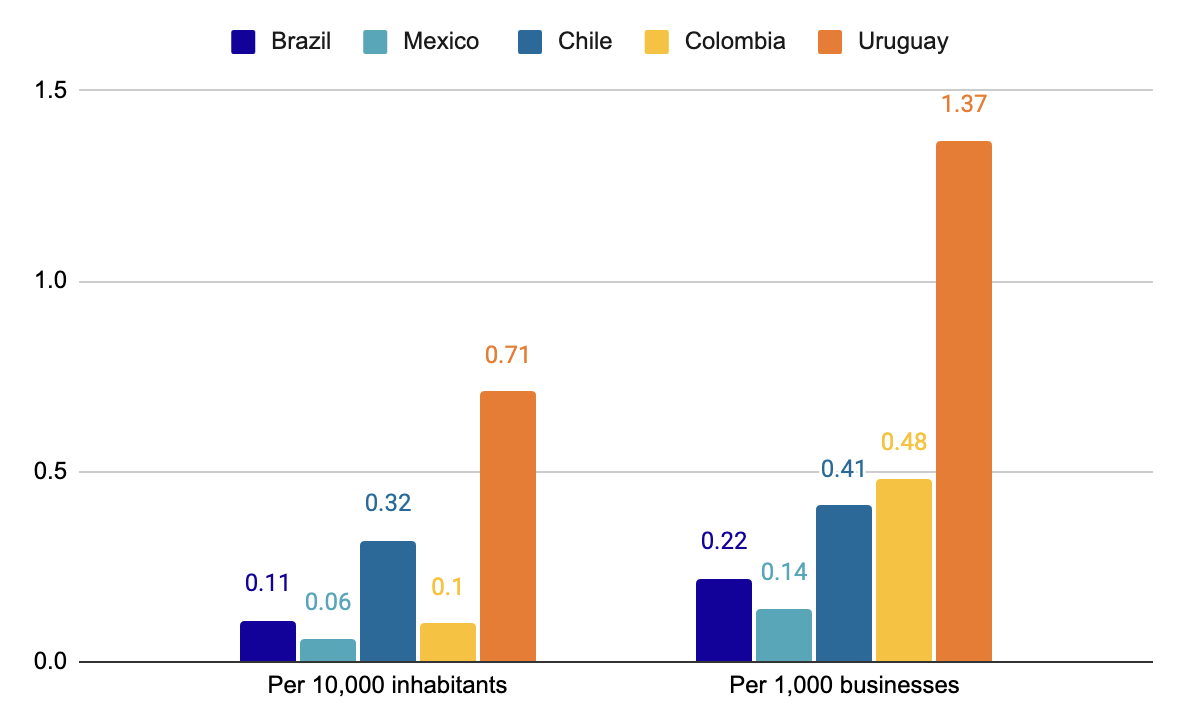
Source: RankMyAI, United Nations, IBGE, Servicio de Impuestos Internos (SII), Informa Colombia, INEGI and Instituto Nacional de Estadística.
Scale and density answer different questions
The two measures should not be treated as alternatives or combined into a single ranking. Absolute figures provide information about the scale of the domestic AI supplier base. On this measure, Brazil is in a very different position from the other countries, accounting for around 51% of the AI tools and companies identified across the five markets.
Relative indicators answer another question: how large is that AI supplier base in relation to the economy in which it operates? From this perspective, smaller economies can have substantial AI activity relative to their size without approaching the absolute numbers found in larger markets.
Colombia also illustrates why it is useful to consider more than one relative measure. Relative to population, its density is close to Brazil's. Relative to the total number of businesses, however, Colombia ranks second among the five countries, behind only Uruguay.
These differences do not mean that one indicator is superior to another, or that greater density by itself implies a more developed AI ecosystem. They capture different dimensions of the structure of domestic AI supply.
Measuring AI ecosystems requires more than one indicator
For policy design and monitoring, this distinction matters. A market with a large absolute number of AI companies has a larger-scale supplier base. High relative density, meanwhile, shows that AI supply represents a comparatively substantial presence within a smaller economy.
Comparisons of national AI ecosystems should therefore consider absolute and relative indicators together. More broadly, the report stresses that the state and development of an AI landscape cannot be assessed through a single indicator: size, composition, geographic distribution, funding, website traffic and international reach provide complementary perspectives.
Methodological note: The study covers AI tools and companies headquartered in Brazil, Chile, Colombia, Mexico and Uruguay that offer AI products or services to external customers. Companies using AI solely for internal purposes, individual freelancers, and academic or experimental projects without market deployment are excluded. The results should therefore be interpreted as a snapshot of the AI landscapes analysed rather than a complete census of all AI activity.
More data and facts
Connected economy
Digital economy
Indicators list
Related SDG
