


The generative AI boom builds on a business base formed over decades in Latin America and the Caribbean, with a marked expansion among today’s active companies founded between 2016 and 2020.
Last updated: 30/10/2026
The business ecosystem associated with artificial intelligence in Latin America and the Caribbean has roots that predate the recent expansion of generative AI. The foundation dates of companies currently associated with AI point to a longer process of business development, particularly during the second half of the 2010s.
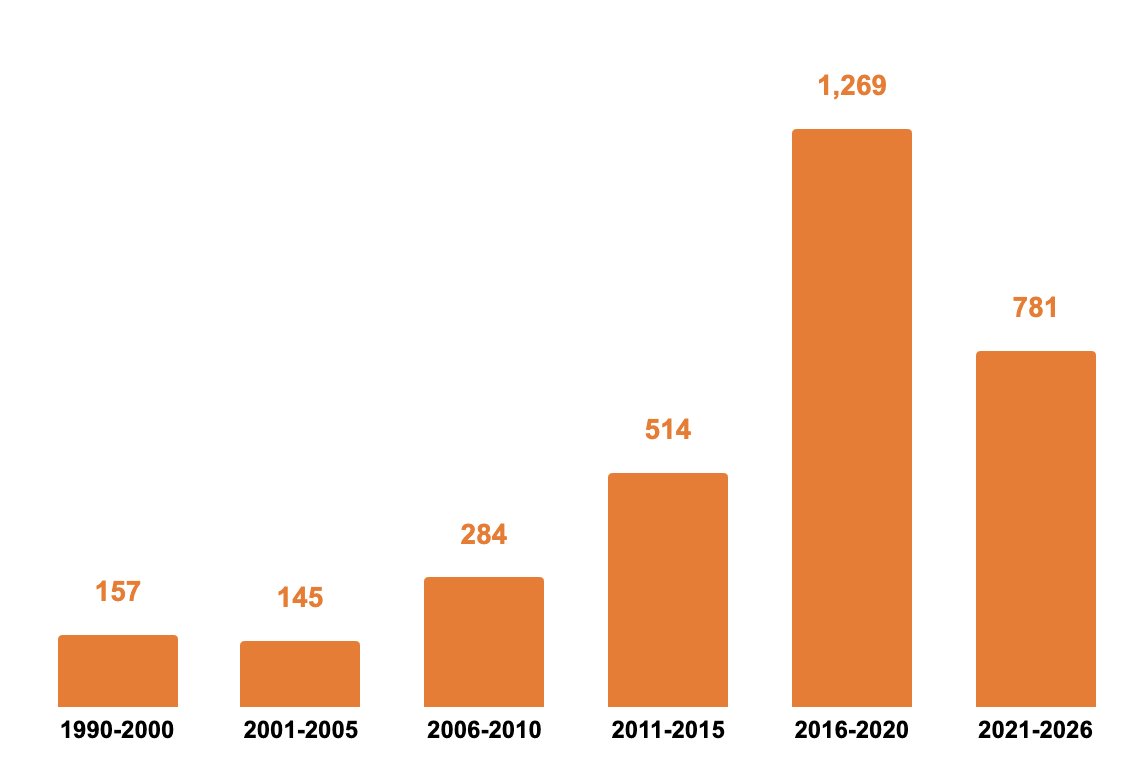
Crunchbase data provide a retrospective view of this process through the foundation years of active AI-related companies. The number of these companies founded in each period increases substantially from 2011 onwards, with the largest cohort founded between 2016 and 2020.
Currently active AI-related companies in Latin America and the Caribbean, by foundation period
Fuente: ECLAC, own elaboration based on Crunchbase data.
Between 2011 and 2015, 514 of the currently active AI-related companies registered in the database were founded. For 2016–2020, this figure rises to 1,269 companies, more than twice the number in the preceding five-year period. A further 781 currently active companies were founded between 2021 and the data cut-off date in 2026.
The larger cohort founded in the second half of the 2010s is evident across the region’s main ecosystems. In Brazil, the number of companies founded rises from 231 in 2011–2015 to 597 in 2016–2020. In Chile, it increases from 53 to 144; in Colombia, from 55 to 138; in Mexico, from 70 to 140; and in Argentina, from 44 to 96.
This pattern therefore extends beyond a single market. Although Brazil accounts for the largest number of companies founded during this period, larger cohorts are observed across several of Latin America and the Caribbean’s main technology ecosystems.
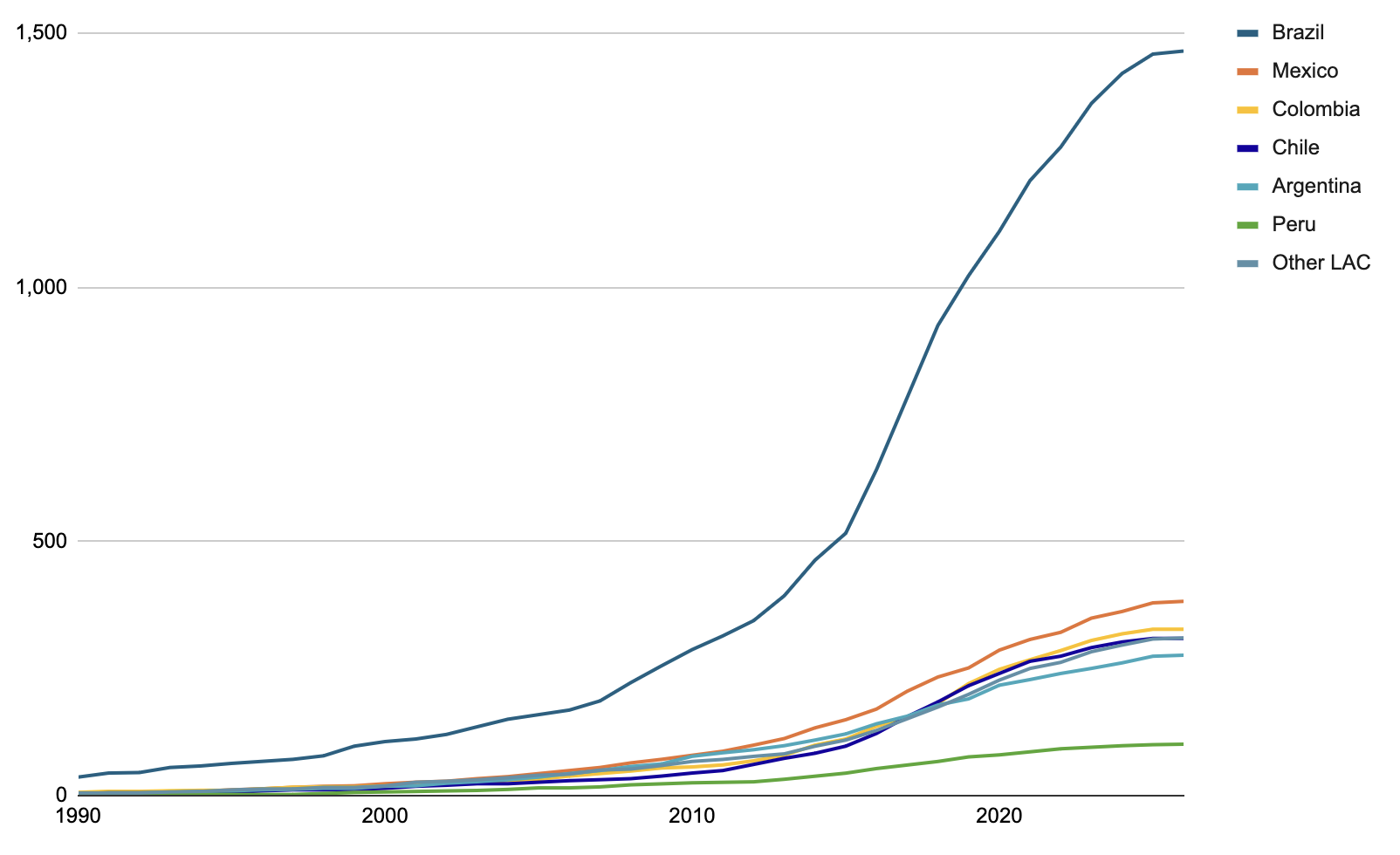
Cumulative number of currently active AI-related companies in Latin America and the Caribbean, by foundation year
Fuente: ECLAC, own elaboration based on Crunchbase data.
Accumulating currently active companies by their foundation year gives a total of 206 founded by 2000, 635 by 2010, 1,147 by 2015, 2,408 by 2020 and 3,170 by 2026. The cumulative count therefore increases more than fifteenfold between 2000 and 2026.
This trajectory shows that many of the companies associated with today’s AI ecosystem were founded well before the recent generative AI boom. The substantial increase in companies founded from the mid-2010s points to an established business base now associated with software, machine learning, data analytics, automation and other technologies within the AI ecosystem. Their foundation dates do not, however, establish when they began undertaking AI-related activities.
The figures after 2020 should be interpreted with caution. The smaller number of companies recorded for 2021–2026 does not, on its own, establish that AI business creation is declining. This is a recent period, ending on 30 May 2026, and young companies may take time to appear or become fully represented in business databases such as Crunchbase. The foundation periods also differ in length. The evidence therefore provides a firmer basis for identifying the large cohort founded between 2016 and 2020 than for establishing a definitive slowdown in recent years.
Taken together, the data reveal the longstanding roots of Latin America and the Caribbean’s current AI-related business base. The challenge is to build on this base so that companies can develop more sophisticated solutions, scale their operations and generate technological capabilities that remain and accumulate within the region.
Methodological note: The data include companies active on 30 May 2026 and classified in Crunchbase’s AI industry group. Companies are grouped by founding year, not when they began AI activities. Counts exclude closed or unlisted companies and do not represent historical totals. Periods vary in length, and the final period is incomplete.
More data and facts
Connected economy
Digital economy
Indicators list
Related SDG
