


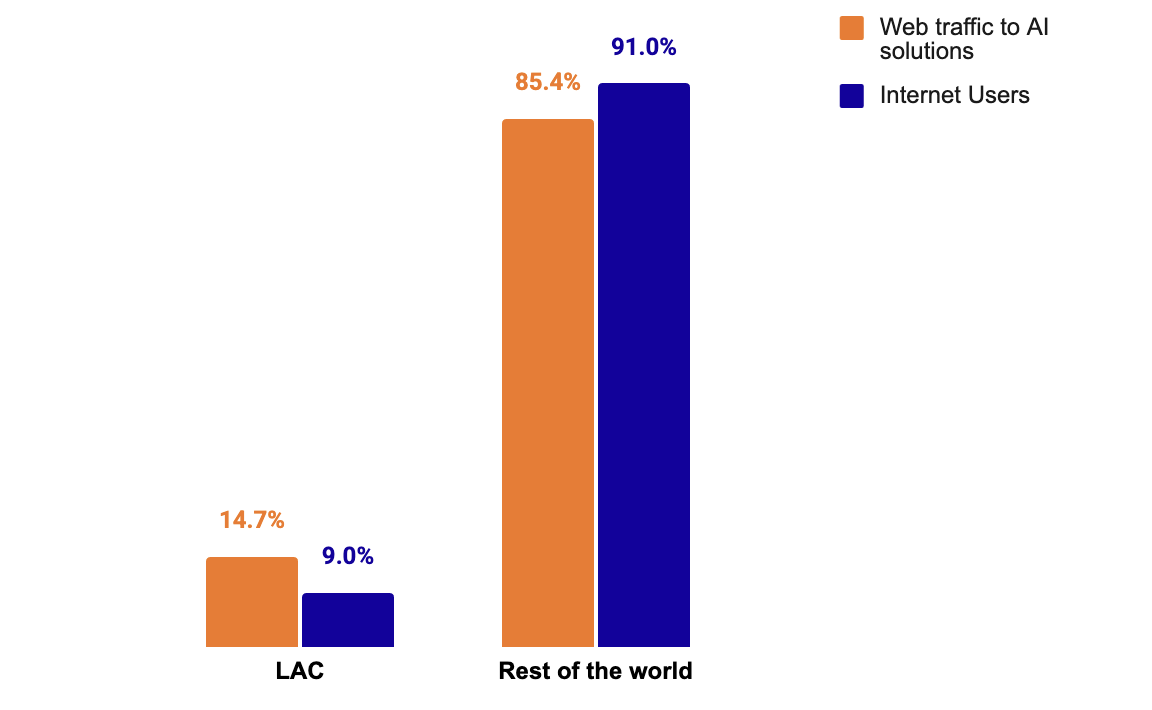
With around 9% of the world’s Internet users, LAC generates 14.6% of traffic to the AI solutions analysed, but this intensity is concentrated in generative applications.
Last updated: 31/10/2026
Latin America and the Caribbean records high traffic to artificial intelligence solutions relative to its share of the world’s Internet users. The 20 countries in the region included in the analysis account for around 9% of global Internet users but generate approximately 14.6% of traffic to the AI solutions analysed.
The difference is considerable: LAC’s share of traffic to AI tools is approximately 1.6 times its share of global Internet users. This indicates particularly intensive interaction with the websites covered by the analysis.
However, total traffic alone does not explain how AI is being used. Adjusting for each country’s number of Internet users reveals substantial differences in both the intensity of visits and the types of tools accessed.
Latin America and the Caribbean’s shares of traffic to AI solutions and global Internet users
Source: Author’s own elaboration based on Similarweb and RankMyAI data.
Market size alone does not explain the intensity of visits
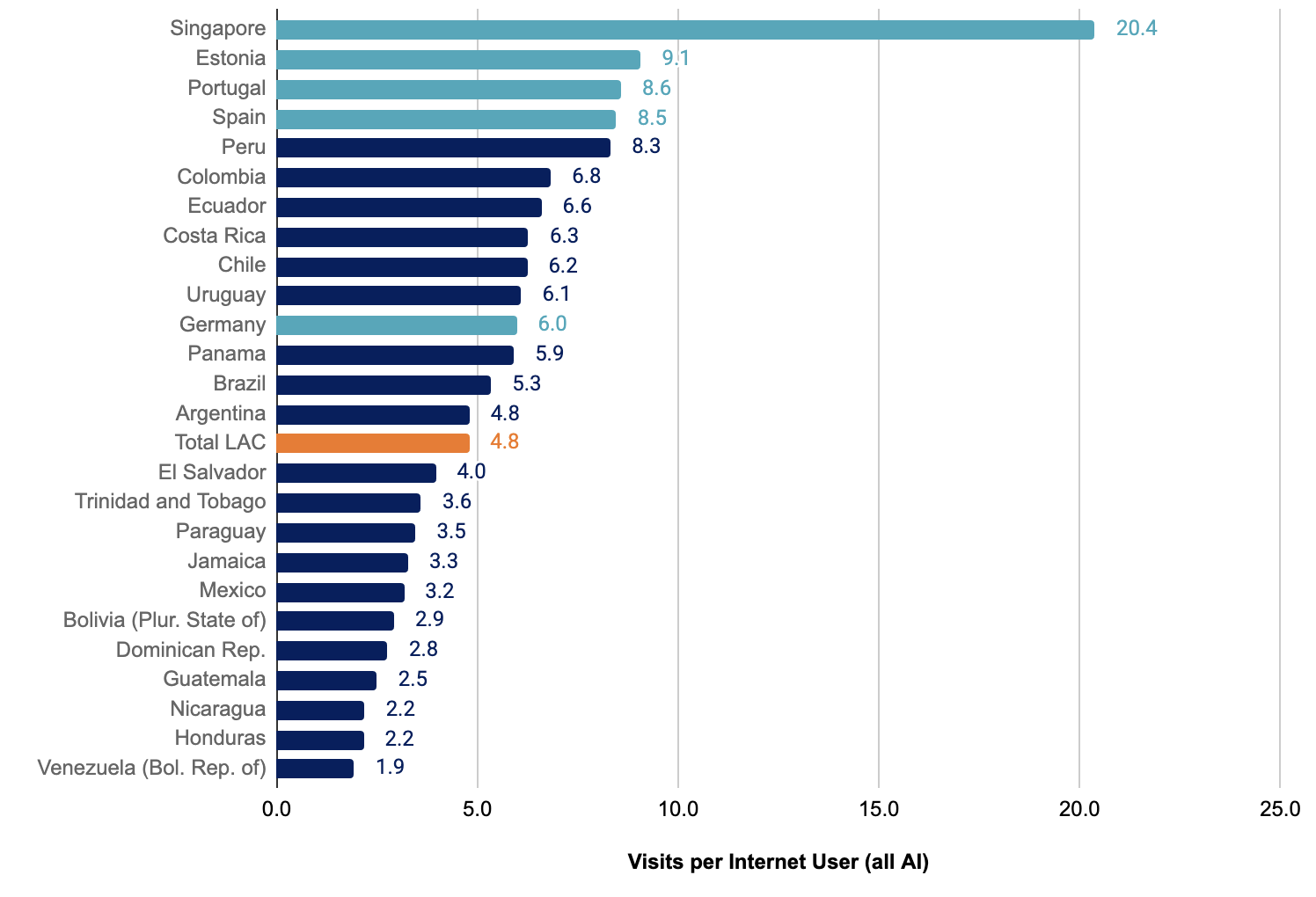
Latin America and the Caribbean records approximately 4.8 visits to AI solutions per Internet user. Peru has the highest intensity among the LAC countries analysed, at around 8.3 visits per Internet user, followed by Colombia (6.8), Ecuador (6.6), Costa Rica (6.3), Chile (6.2), Uruguay (6.1) and Panama (5.9).
This perspective complements the picture provided by absolute traffic volumes. Brazil and Mexico account for a substantial share of regional traffic because of the size of their digital markets, but several countries with much smaller Internet-user populations record proportionally more visits.
Peru, for example, generates far fewer total visits than Brazil, but records the highest intensity among the LAC countries analysed when traffic is divided by the number of Internet users.
Intensity of visits to AI solutions, Latin America and the Caribbean and selected countries
Source: Author’s own elaboration based on Similarweb and RankMyAI data.
The region’s high intensity of visits is driven mainly by generative AI
The type of solution accessed introduces a second dimension. LAC records around 4.0 visits per Internet user to generative AI solutions, compared with approximately 0.83 visits to AI models and APIs, open-source tools and development platforms.
These two categories reflect different ways of interacting with the AI ecosystem. Generative solutions give users direct access to capabilities such as generating text, images and other content. Models, APIs and development platforms, meanwhile, can support experimentation with models, application development and the integration of AI capabilities into other products and services.
Website traffic to the latter category does not directly measure AI production or integration within businesses. It does, however, provide a complementary indication of interaction with components and tools that enable users to build on AI technologies, beyond directly using finished applications.
Countries in the region show different patterns
Differences extend beyond the overall intensity of visits. Some countries stand out particularly for traffic to generative AI solutions, while others record relatively greater intensity in visits to development-oriented tools.
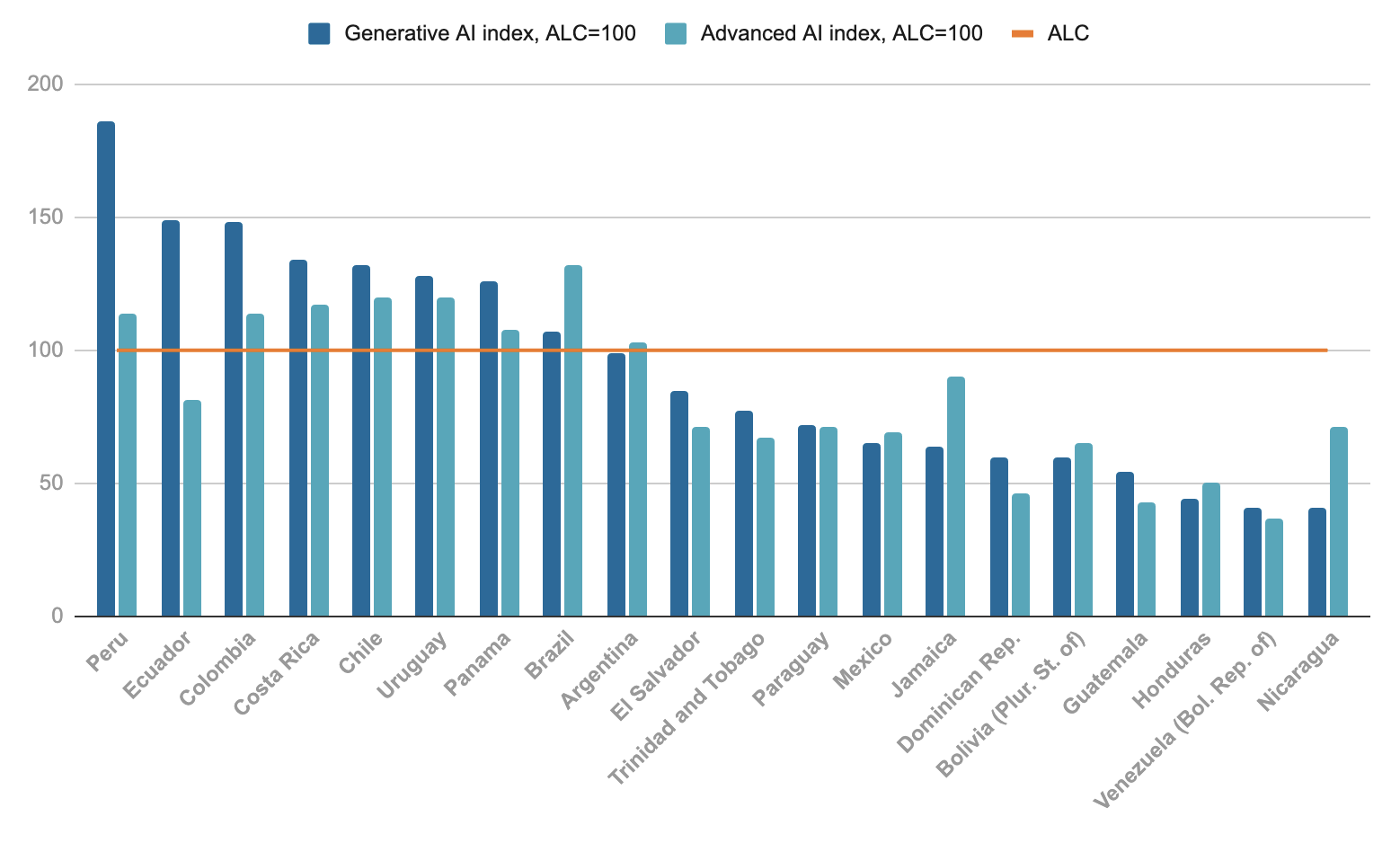
Using the regional benchmark of LAC = 100, Peru records an index of approximately 186 for generative AI visits, but around 114 for models, APIs and development platforms. Ecuador shows an even greater contrast: approximately 149 for generative AI, but only 81 for development-oriented tools.
Intensity of visits to generative AI solutions and AI development tools, selected Latin American and Caribbean countries (Index of visits per Internet user, LAC = 100)
Source: Author’s own elaboration based on Similarweb and RankMyAI data.
Brazil shows a different pattern. Its intensity of visits to generative AI solutions is only slightly above the regional benchmark, at 107, but it records the highest value in LAC for development tools, with an index of approximately 132.
Chile and Uruguay have more balanced profiles: both are clearly above the regional benchmark for generative AI and for models, APIs and development platforms. Colombia also combines very high intensity of visits to generative solutions with above-benchmark visits to development tools.
These findings show that a high overall intensity of visits to AI solutions does not necessarily imply the same pattern of interaction with the technological ecosystem.
International comparisons reveal a gap in visits to development tools
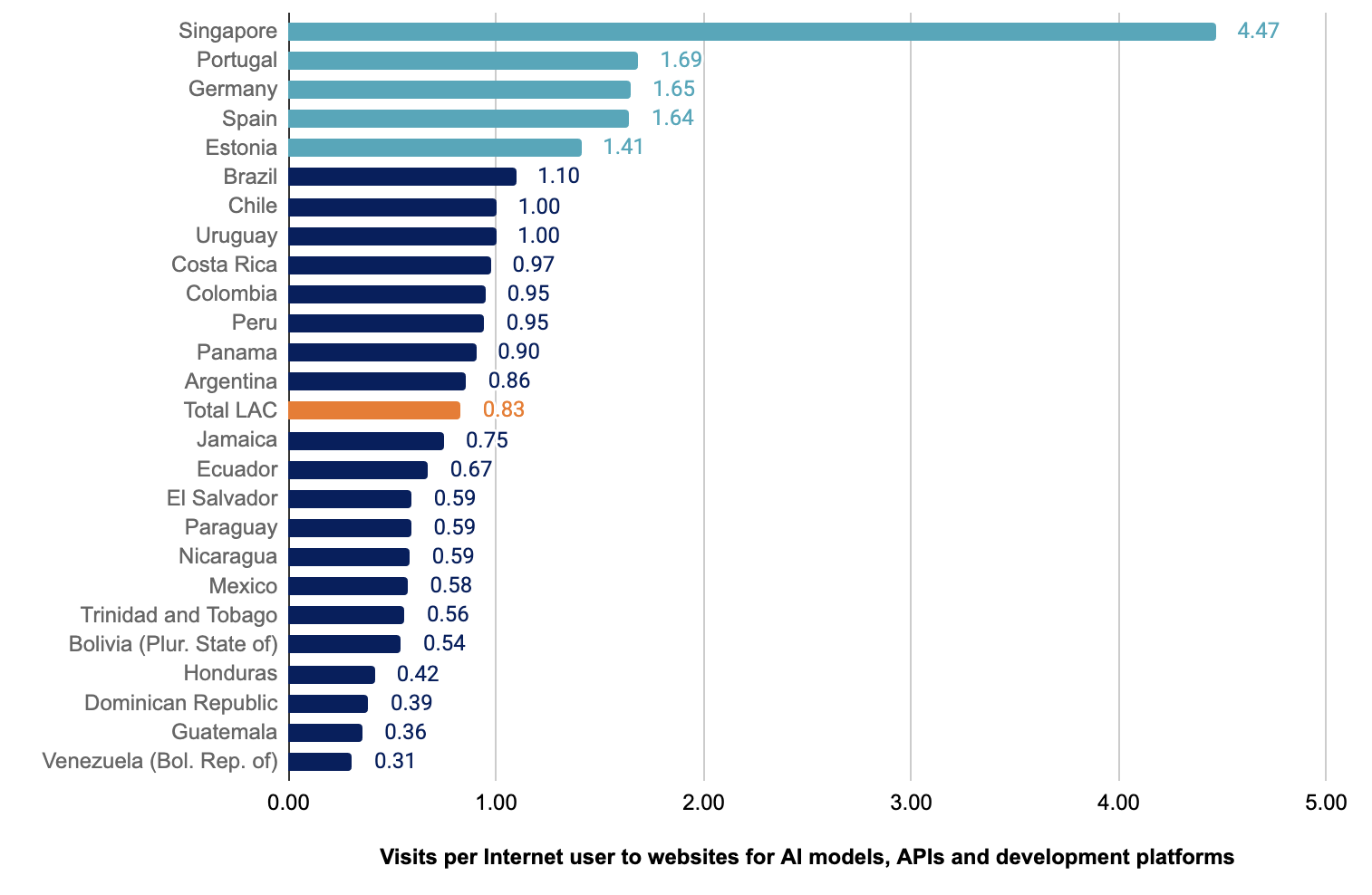
Comparison with selected countries outside the region puts these findings into perspective. While LAC records approximately 0.83 visits per Internet user to models, APIs, open-source tools and development platforms, this figure reaches around 1.41 in Estonia, 1.64 in Spain, 1.65 in Germany and 1.69 in Portugal. In Singapore, it exceeds 4.4 visits per Internet user.
Intensity of visits to AI models, APIs and development platforms, Latin America and the Caribbean and selected countries
Source: Author’s own elaboration based on Similarweb and RankMyAI data.
In other words, several comparison countries record approximately 1.7 to 2 times LAC’s intensity of visits to these tools, while Singapore stands well above both groups.
The comparison should be interpreted with caution: it is not a direct measure of national technological capabilities or business adoption. Nevertheless, it suggests that LAC’s high intensity of AI website traffic is concentrated particularly in tools directly accessible to end users, while traffic to components that support the development, adaptation or integration of AI solutions is comparatively lower.
From widespread interaction to broader engagement with the AI ecosystem
The data show high intensity of web traffic to the AI solutions analysed in Latin America and the Caribbean. The region generates a considerably larger share of this traffic than its share of global Internet users.
The challenge that emerges is therefore to broaden the ways these technologies are used.
Greater engagement with models, APIs, open-source tools and development platforms could support experimentation, adaptation and the creation of solutions tailored to specific productive and social needs. Alongside access to tools, this requires technical skills, talent, digital infrastructure, data and organizational conditions that enable more diverse applications of artificial intelligence.
Methodological note: The analysis combines Similarweb web traffic estimates with information from RankMyAI and a functional classification distinguishing between generative AI and development tools. Intensity is measured as visits per Internet user, rather than the number of unique users. The data do not capture all AI uses, particularly those within companies’ internal systems.
More data and facts
Connected economy
Digital economy
Indicators list
Related SDG
