


Brazil accounts for around 85% of the region’s identified high-performance computing capacity: expanding data centres alone will not close the gap in access to scientific computing
Last updated: 31/10/2026
High-performance computing (HPC) has become a strategic infrastructure for science, competitiveness and artificial intelligence development. It enables computationally intensive tasks such as climate modelling, genomic analysis, drug design and AI model training.
Latin America and the Caribbean, however, faces a substantial scientific computing gap. The challenge is not simply to attract new data centres, but to ensure reliable access to computing capacity for universities, public institutions and productive sectors.
HPC capacity is highly concentrated
Brazil accounts for around 85% of the region’s identified HPC capacity, followed at a considerable distance by Argentina, Mexico and Colombia. Meanwhile, 10 of the 19 countries analysed in the 2025 Latin American Artificial Intelligence Index (ILIA) have no identifiable HPC infrastructure. For these countries, regional or shared access is a basic requirement for participating in computationally intensive scientific activities.
Distribution of HPC capacity in Latin America and the Caribbean
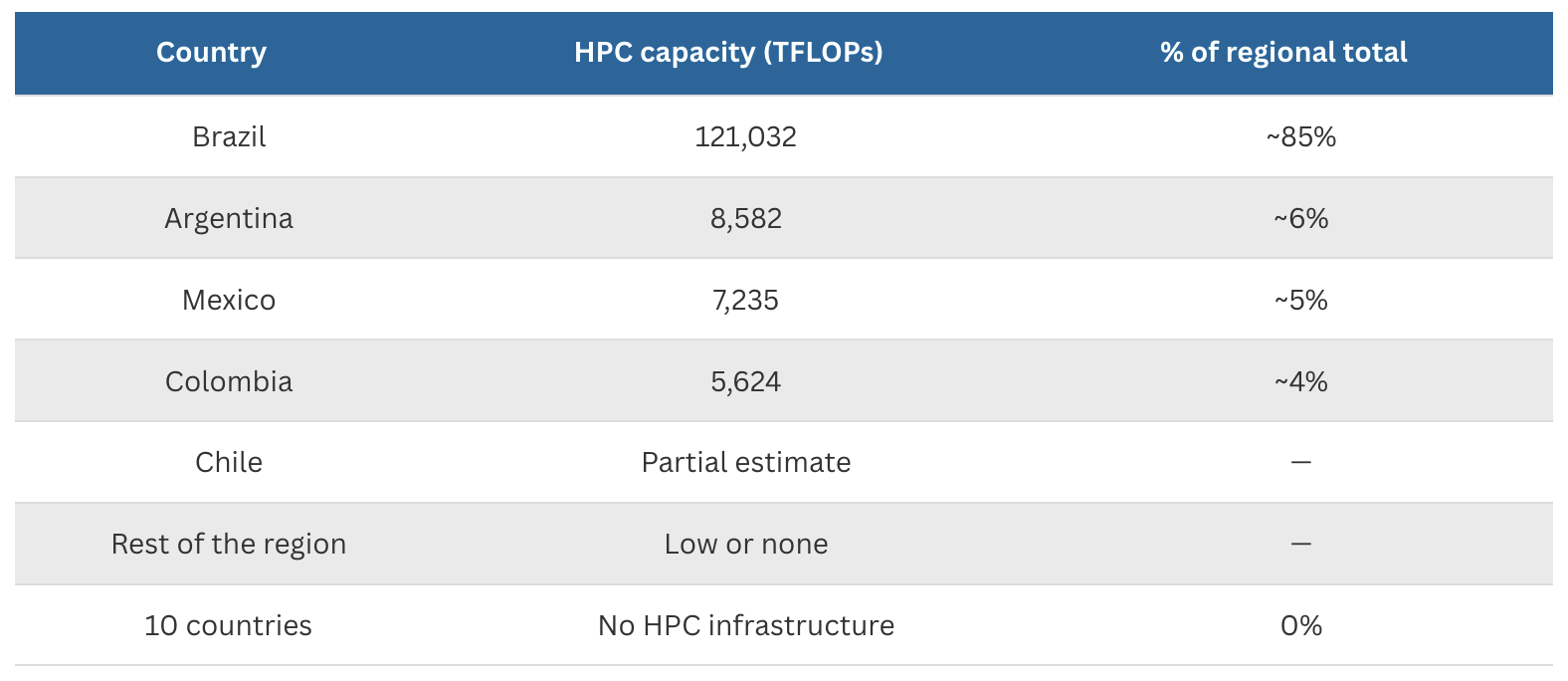
Fuente: ILIA 2025 (CEPAL/CENIA)
The gap with the global frontier is also substantial. Santos Dumont, the region’s most powerful public scientific computing system, reaches 14.3 PFLOPs, less than 1% of the peak performance of the world’s leading system in 2026.
More data centres do not necessarily mean more scientific computing capacity
The report distinguishes between HPC, commercial data centres and hyperscale infrastructure. Although they share technological components, they serve different functions. Commercial data centres and cloud infrastructure primarily serve digital services and market demand, while HPC is designed for highly computationally intensive scientific and engineering workloads.
A country can therefore rapidly expand its cloud and data centre infrastructure while remaining dependent on external computing capacity to run advanced climate models, conduct scientific research or handle certain AI workloads. These infrastructures are complementary, but are not substitutes for one another.
Announced investment is dominated by commercial infrastructure
Between 2024 and 2026, more than US$80 billion in digital infrastructure investment was announced in the region. Around 70% relates to hyperscale and commercial colocation infrastructure, while only approximately US$9.5 billion is classified as firm commitments with identified financing and implementation underway.
HPC expansion also faces constraints beyond capital. GPU availability, dependence on particular hardware and software ecosystems, access to energy and water, and the availability of specialized talent all shape the effective capacity to deploy and operate these systems.
Cooperation can broaden access
The region already has cooperation mechanisms such as SCALAC/RedCLARA and the EU–LAC Supercomputing Network. The report argues that the response does not require every country to build frontier infrastructure independently, but instead calls for stronger shared access, coordinated procurement, talent development and technological diversification.
The aim is not to reach the global supercomputing frontier, but to secure sufficient computing capacity that can be managed in line with regional priorities such as climate, health, energy, food and applied AI. Expanding digital infrastructure therefore translates into greater AI capabilities only when it is accompanied by effective access to computing resources, talent and the institutional conditions needed to use them.
Methodological note: The report distinguishes between HPC, commercial data centres and hyperscale infrastructure, whose capacities and metrics are not directly equivalent. Investment figures cover projects at different stages of development, distinguishing announcements from firm commitments.
Source: SmC+ and GIZ (2026), Infraestructura digital para la era de la Inteligencia Artificial. HPC en América Latina: estado del arte, perspectivas y oportunidades de cooperación.
More data and facts
Connected economy
Digital economy
Indicators list
Related SDG
