


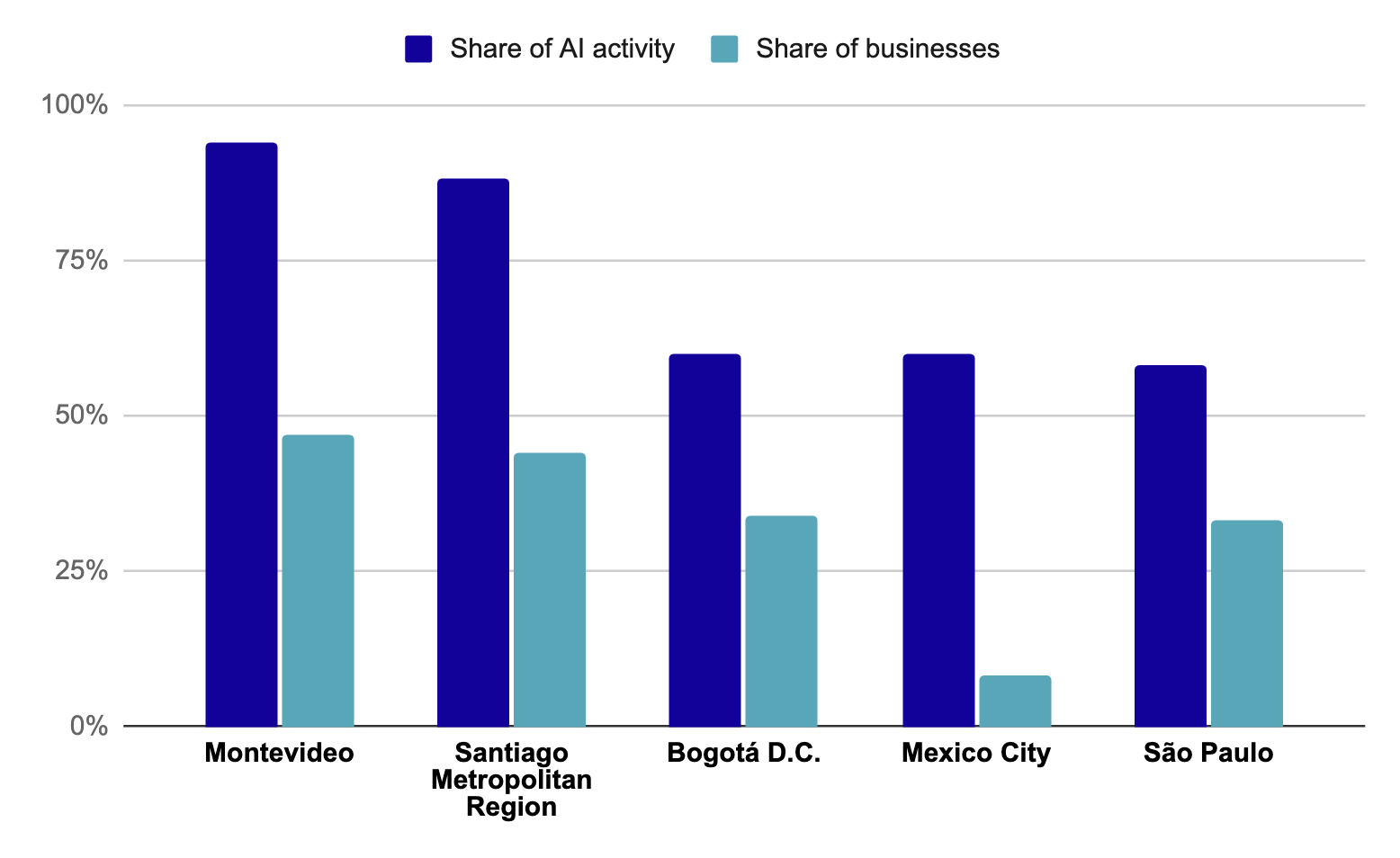
Mexico City is home to 60% of the AI tools and companies identified in Mexico and just 8% of all its businesses, the widest gap among the five countries studied.
Last updated: 11/11/2026
AI tools and companies in Brazil, Chile, Colombia, Mexico and Uruguay are concentrated in a relatively small number of regions. In all five countries, this concentration is greater than the geographic concentration of business activity overall.
The difference is visible when comparing the share of AI activity located in each country's leading administrative region. In Brazil, São Paulo accounts for 58% of AI tools and companies, compared with 33% of all businesses. In Colombia, Bogotá D.C. accounts for 60% of AI activity, compared with 34% of businesses. The contrast is particularly large in Mexico: Mexico City accounts for 60% of AI tools and companies, but only 8% of businesses.
Concentration is even higher in Chile and Uruguay. The Santiago Metropolitan Region accounts for 88% of Chile's AI tools and companies, compared with 44% of businesses. In Uruguay, Montevideo accounts for 94% of AI activity, compared with 47% of businesses.
Concentration of AI tools and companies and overall business activity in each country's leading region
Source: Author's own elaboration based on data from RankMyAI, IBGE, Servicio de Impuestos Internos (SII), Informa Colombia, INEGI and Instituto Nacional de Estadística.
Geographic presence and concentration are not the same thing
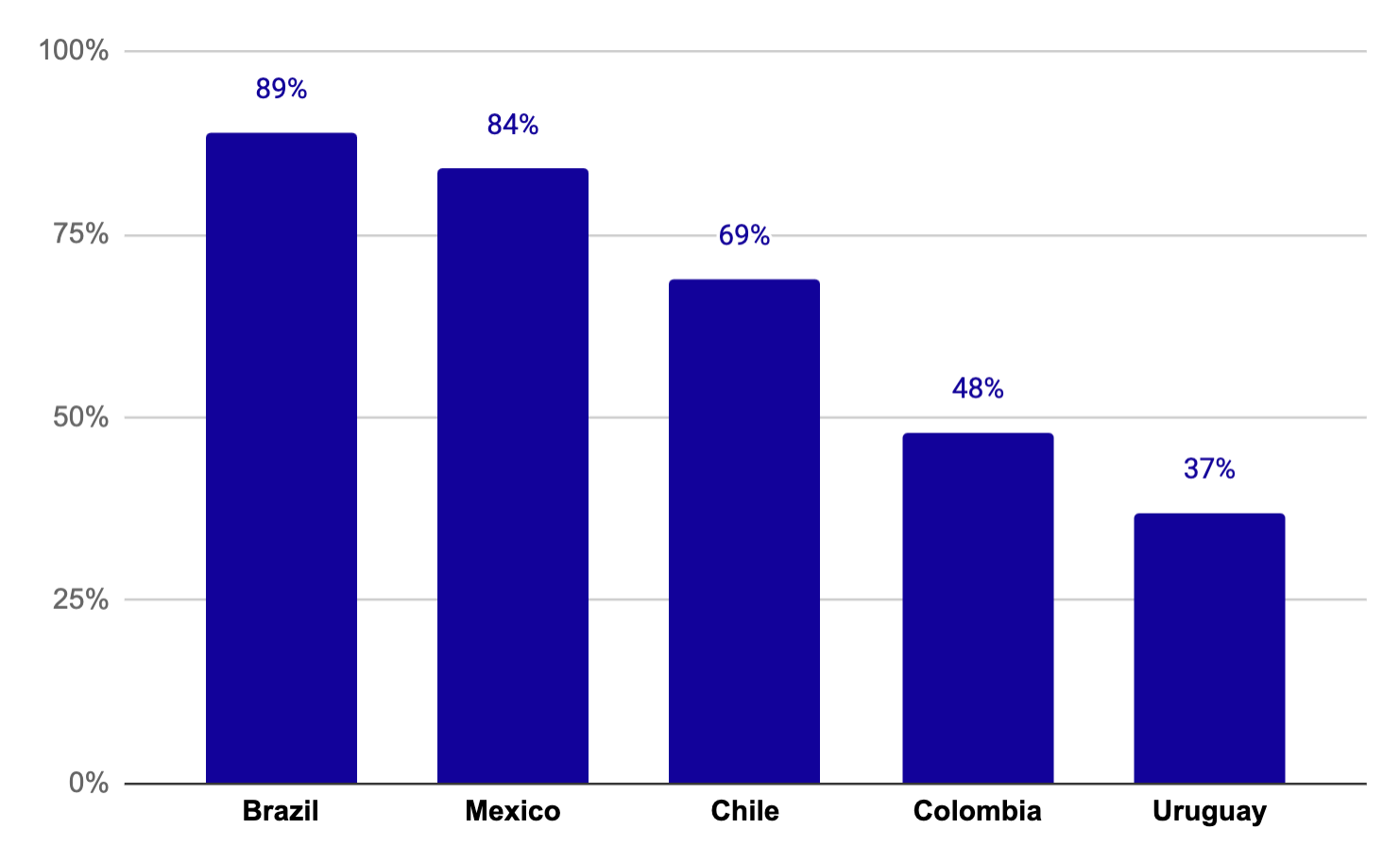
The territorial presence of AI companies also differs substantially across countries. Brazil and Mexico have the broadest geographic coverage. AI tools and companies were identified in 24 of Brazil's 27 states (89%) and 27 of Mexico's 32 states (84%). In Chile, AI activity is present in 11 of 16 regions (69%), compared with 16 of 33 departments in Colombia (48%) and 7 of 19 departments in Uruguay (37%).
However, presence across many regions does not mean that activity is evenly distributed. Brazil and Mexico combine broad territorial coverage with substantial concentration in São Paulo and Mexico City. Chile and Uruguay have both narrower territorial coverage and much higher concentration in their capital regions.
Geographic presence of AI tools and companies in five Latin American countries
Share of first-level administrative divisions with identified AI tools and companies
Source: Author's own elaboration based on data from RankMyAI.
Two different patterns of geographic concentration
The data point to two broad configurations. In Chile and Uruguay, AI activity is highly concentrated in the capital region: Santiago and Montevideo account for 88% and 94% of AI tools and companies respectively. The report's geographic concentration index confirms this pattern. Uruguay has a normalised HHI of 0.88 and Chile 0.76, the highest levels among the five countries.
Brazil, Colombia and Mexico also show strong concentration in their leading hubs, but they have more substantial AI activity outside them. The report notes, for example, that Medellín accounts for more than one fifth of Colombia's AI tools and companies, while Nuevo León is Mexico's second-largest AI centre. Brazil also has meaningful AI activity beyond São Paulo.
These differences show that concentration in a dominant national hub can coexist with very different levels of secondary-hub development.
What does this mean for AI development policy?
Geographic concentration can provide advantages to AI companies by facilitating access to specialised talent, research institutions, investors and other AI companies. At the same time, high concentration may also indicate that conditions for AI development differ substantially between regions. The report explicitly highlights both dimensions.
AI development policy therefore starts from a different geographic structure in each country. In some cases, there may be scope to strengthen secondary hubs that are already visible; in others, activity remains much more strongly centred in a single region. Decisions on whether to reinforce existing hubs, encourage AI development elsewhere, or combine both approaches should take account of the specific territorial structure of each national ecosystem.
Methodological note: The analysis compares the geographic distribution of AI tools and companies identified by RankmyAI with the overall distribution of businesses in Brazil, Chile, Colombia, Mexico and Uruguay. The comparison is conducted at the level of first-level administrative divisions. Geographic presence measures the number of these divisions in which AI tools and companies were identified. Concentration is assessed using both the share accounted for by the leading region and a normalised Herfindahl-Hirschman Index. The index ranges from 0, representing an even distribution across administrative divisions, to 1, indicating that all activity is concentrated in a single division.
More data and facts
Connected economy
Digital economy
Indicators list
Related SDG
