


Using AI and knowing how to develop it are distinct capabilities: Chile, Argentina and Mexico stand out in the diffusion of technical skills, opening opportunities for the region to create and adapt these technologies too.
Last updated: 27/10/2026
The diffusion of artificial intelligence depends not only on access to these technologies. It is also linked to their effective use and to the development of the skills needed to build, adapt and deploy AI systems.
Two recent sources provide complementary perspectives on these dimensions. Microsoft’s data estimate the share of the working-age population using generative AI tools in each country. LinkedIn’s AI Skills Diffusion Index, meanwhile, makes it possible to examine how AI-related skills are evolving, including those specifically associated with engineering and developing these systems.
Together, these indicators show that AI diffusion is progressing at different rates across countries, and that greater use of AI tools does not necessarily imply a comparable level of development in the technical skills needed to produce and adapt them.
Generative AI use varies widely across countries
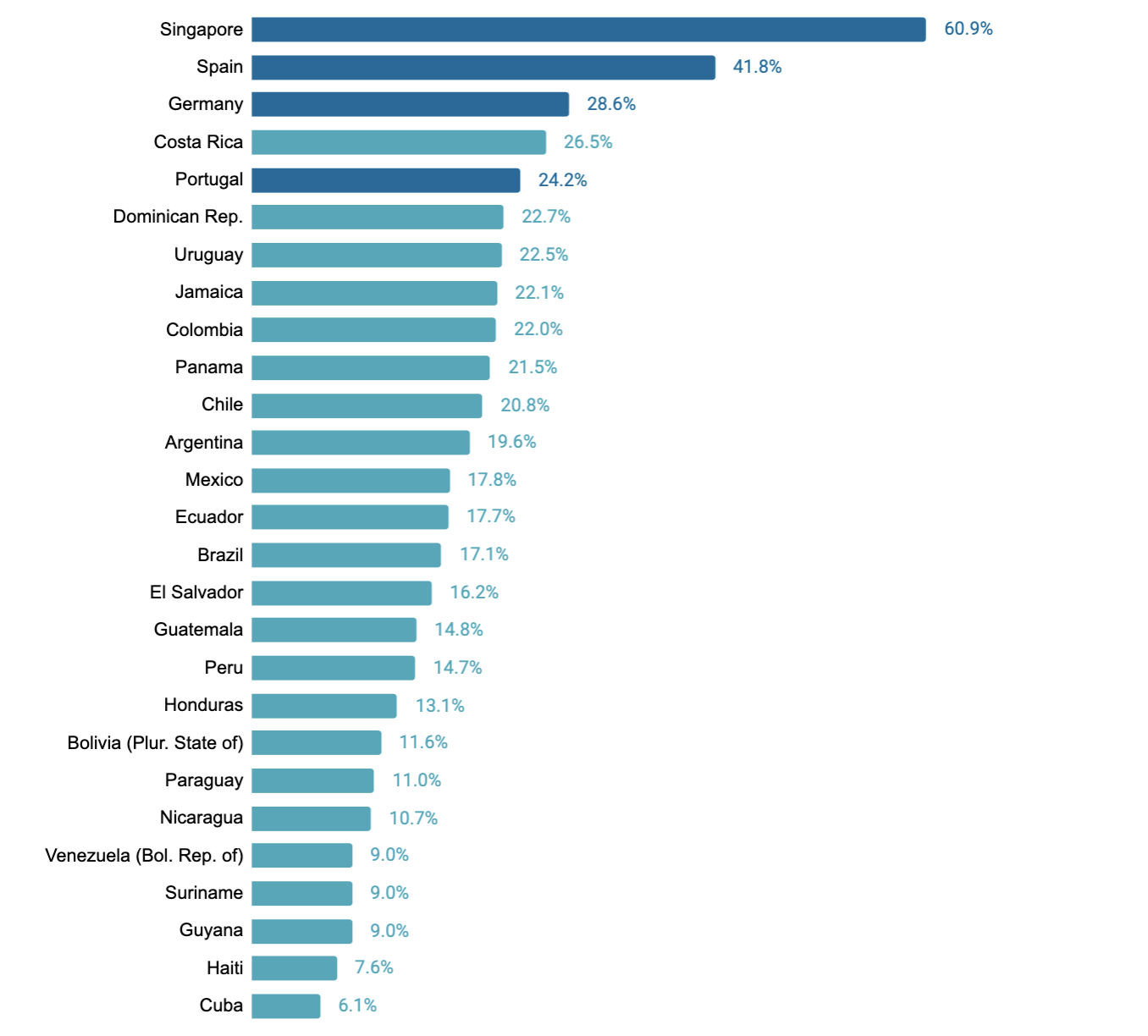
Microsoft’s estimates show substantial differences in the use of generative AI tools across Latin America and the Caribbean. Among the countries included in the figure, Costa Rica records the highest share of users within the working-age population, at 26.5%, followed by the Dominican Republic (22.7%), Uruguay (22.5%), Jamaica (22.1%) and Colombia (22.0%). At the other end of the spectrum, Cuba (6.1%) and Haiti (7.6%) record the lowest shares.
Working-age population using generative AI, by country, 2025
Source: Author's own elaboration using information from Microsoft, “Global AI Adoption in 2025: A Widening Digital Divide”.
International comparisons also reveal contrasts. Singapore reaches 60.9% and Spain 41.8%, exceeding all the Latin American and Caribbean countries represented. However, Costa Rica surpasses Portugal (24.2%) and approaches Germany (28.6%), showing that some countries in the region record levels of use comparable to those of high-income economies.
These differences describe how widely generative AI tools are used, but do not, on their own, indicate each country’s capacity to develop or adapt these systems. Exploring this second dimension also requires examining the diffusion of specialized technical skills..
AI engineering skills are also spreading
The use of AI tools represents only one dimension of this transformation. Their deeper integration into production processes also requires the skills needed to develop, adapt and deploy artificial intelligence systems.
LinkedIn introduced the AI Skills Diffusion Index to measure how much the adoption of AI skills has increased within each country relative to its own baseline. The indicator therefore measures the intensity with which these skills are spreading relative to each country’s starting point, rather than the absolute number of specialists in an economy.
LinkedIn distinguishes between AI literacy skills, associated with familiarity with and use of AI-enabled tools, and AI engineering skills, associated with building and deploying artificial intelligence systems. Although both have increased in many countries, AI literacy skills tend to spread more rapidly.
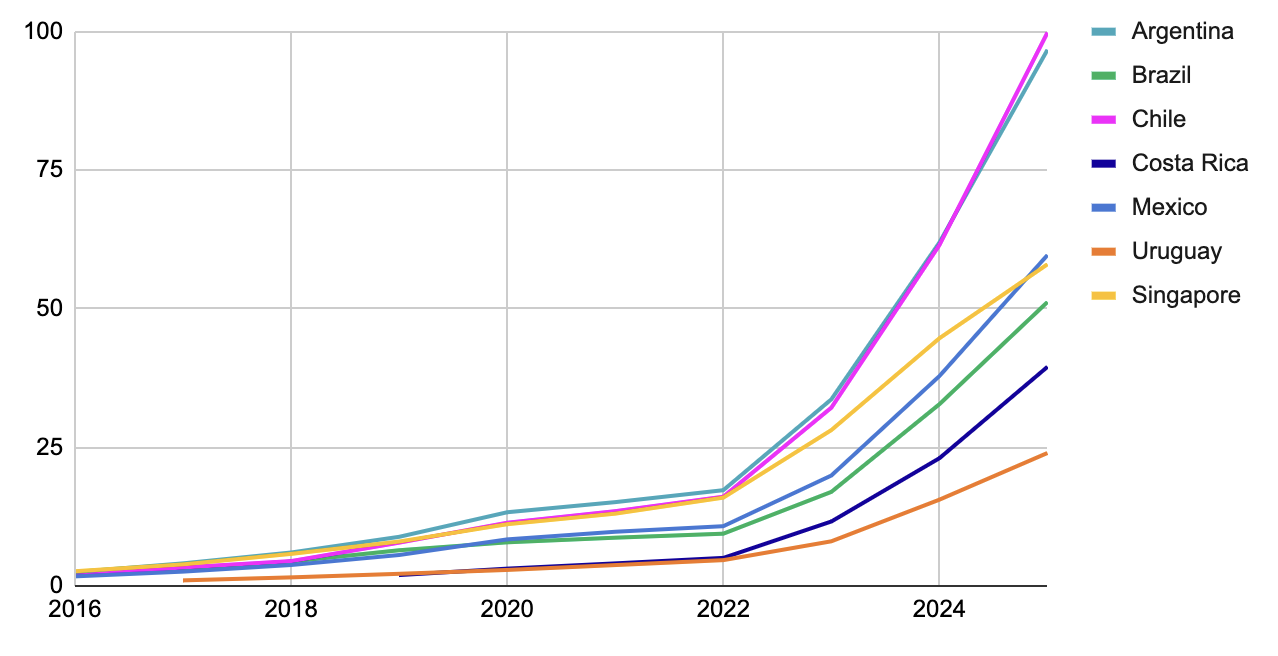
Trends in AI engineering skills diffusion, selected countries, 2016–2025
Source: Author’s own elaboration based on LinkedIn data presented in Stanford University’s AI Index Report 2026.
The evolution of LinkedIn’s index reveals different trajectories across the countries analysed. While some show sustained growth in AI engineering capabilities, expansion has been more moderate in others.
Within Latin America, several countries stand out for the accelerating diffusion of technical skills in recent years. This finding is consistent with LinkedIn’s evidence, which identifies Chile, alongside the United Arab Emirates and South Africa, among the countries experiencing rapid recent growth in AI engineering skills.
Tracking changes over time is important because it reveals a different phenomenon from the current stock of talent. A country starting from a relatively small base may experience rapid diffusion of new skills, while an economy with a large concentration of specialists may record slower growth.
The figure therefore helps identify where the accumulation of skills related to AI development and deployment is accelerating, rather than where the largest pool of talent is currently concentrated.
Several Latin American countries improve their relative positions
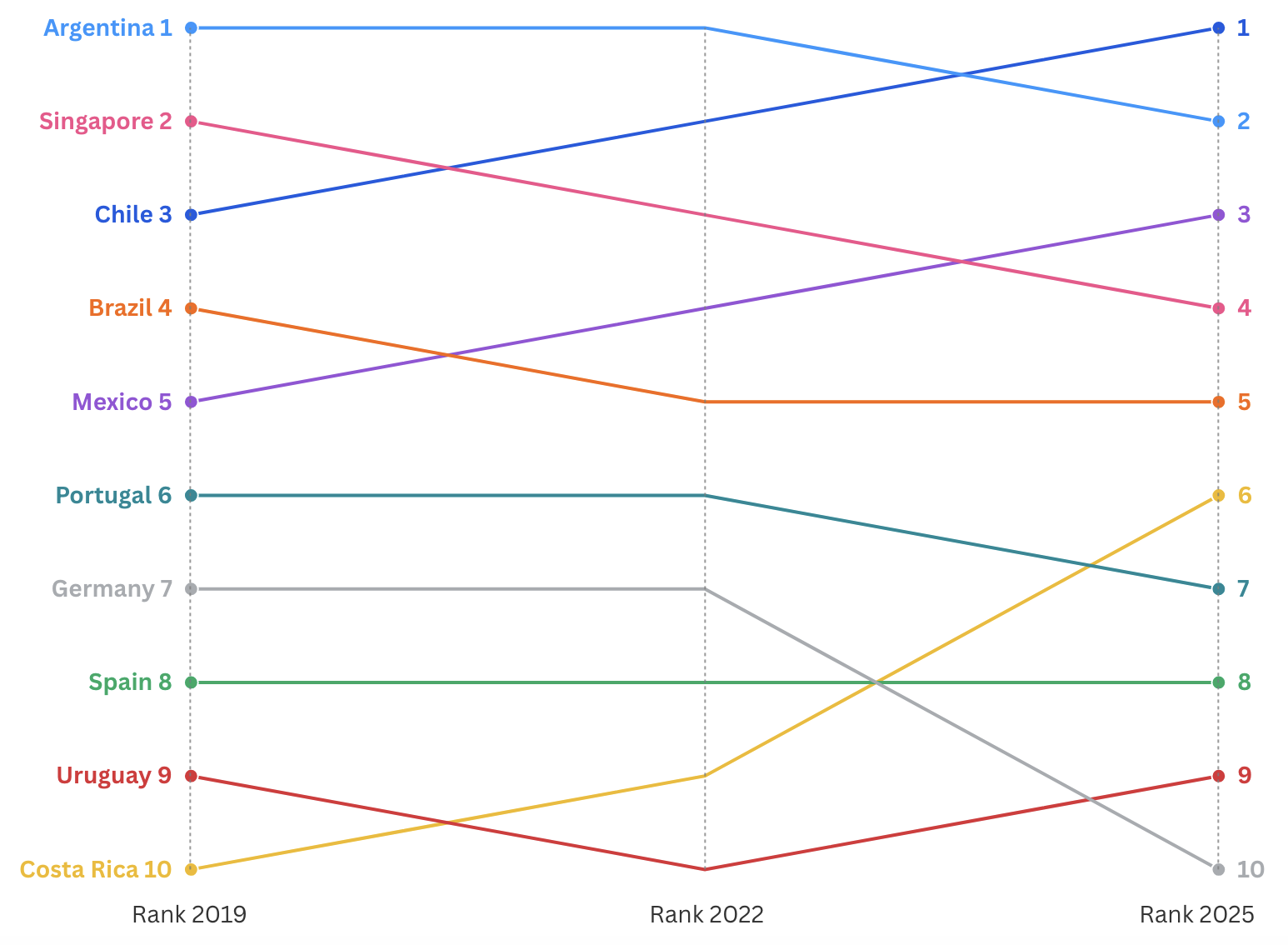
This transformation is also reflected in changes in the relative positions of the selected countries. Chile records one of the most notable advances, moving from third place in 2019 to first in 2025. Argentina, which ranked first in both 2019 and 2022, places second in 2025. Mexico also improves considerably, moving from fifth to third place, while Costa Rica advances from tenth to sixth. Uruguay, meanwhile, ranks ninth in both 2019 and 2025.
Relative position in AI engineering skills diffusion, selected countries, 2019, 2022 and 2025
Source: Author’s own elaboration based on LinkedIn data presented in Stanford University’s AI Index Report 2026.
Among the comparison economies, Singapore moves from second to fourth place, Portugal from sixth to seventh, and Spain remains in eighth place. Germany records the largest decline in rank within the group, moving from seventh to tenth.
These shifts show that the diffusion of specialized AI capabilities extends beyond the economies that traditionally concentrate the largest pools of technology talent. Some Latin American countries are advancing rapidly relative to both their own starting points and the other countries included in the comparison.
The ranking must, however, be interpreted with caution. A higher position means that AI engineering skills have spread more intensively according to LinkedIn’s methodology. It does not mean that Chile, Argentina or Mexico currently have more AI specialists than Germany, Singapore or other advanced economies.
From adopting tools to developing capabilities
The three figures illustrate complementary dimensions of artificial intelligence diffusion. Microsoft’s data estimate how widely generative AI tools are being used by the working-age population. LinkedIn’s data reveal a second dimension: the pace at which the skills needed to develop and deploy AI systems are spreading. Changes in the ranking, in turn, identify which countries are advancing most rapidly within the group considered.
For Latin America and the Caribbean, this distinction is particularly relevant. The region still faces challenges in expanding the use of artificial intelligence across businesses and organizations, but trends in engineering skills show signs of dynamism in some countries.
The challenge is to translate this diffusion of skills into cumulative learning and productive capacity. This requires connecting specialized talent with businesses, research centres and productive sectors that can put it to use, alongside the computing infrastructure, data and organizational conditions needed to develop and adapt AI solutions.
The transformative diffusion of artificial intelligence therefore requires progress on both fronts: expanding the use of these technologies and developing the capabilities needed to integrate, adapt and produce them.
Methodological note: Figure 1 uses Microsoft telemetry data. Microsoft’s indicator estimates the share of the working-age population using generative AI tools. It draws on aggregated and anonymized activity data observed within the Microsoft ecosystem, primarily Windows devices, to identify the use of major AI services. These estimates are adjusted for differences in device access, mobile use, connectivity and population. Figures 2 and 3 are based on LinkedIn’s AI Skills Diffusion Index. This indicator measures growth in the adoption of AI skills within each country relative to its own baseline. AI engineering skills encompass skills associated with building and deploying artificial intelligence systems. Both the index values and relative positions should therefore be interpreted as indicators of skills diffusion, rather than measures of the absolute size of the AI talent pool.
More data and facts
Connected economy
Digital economy
Indicators list
Related SDG
