


Digital infrastructure is expanding in Latin America and the Caribbean, but its AI supercomputing capacity has stagnated since 2023, while the world’s leading regions continue to advance.
Fecha última revisión: 10/02/2025
The rapid expansion of artificial intelligence is increasing the strategic importance of the physical infrastructure required to store, process and move large volumes of data. Data centers, cloud infrastructure and advanced computing systems have become key enabling assets for the development and deployment of AI. Their geographic distribution therefore provides an indication of the capacity of countries and regions to participate in an increasingly compute-intensive digital economy.
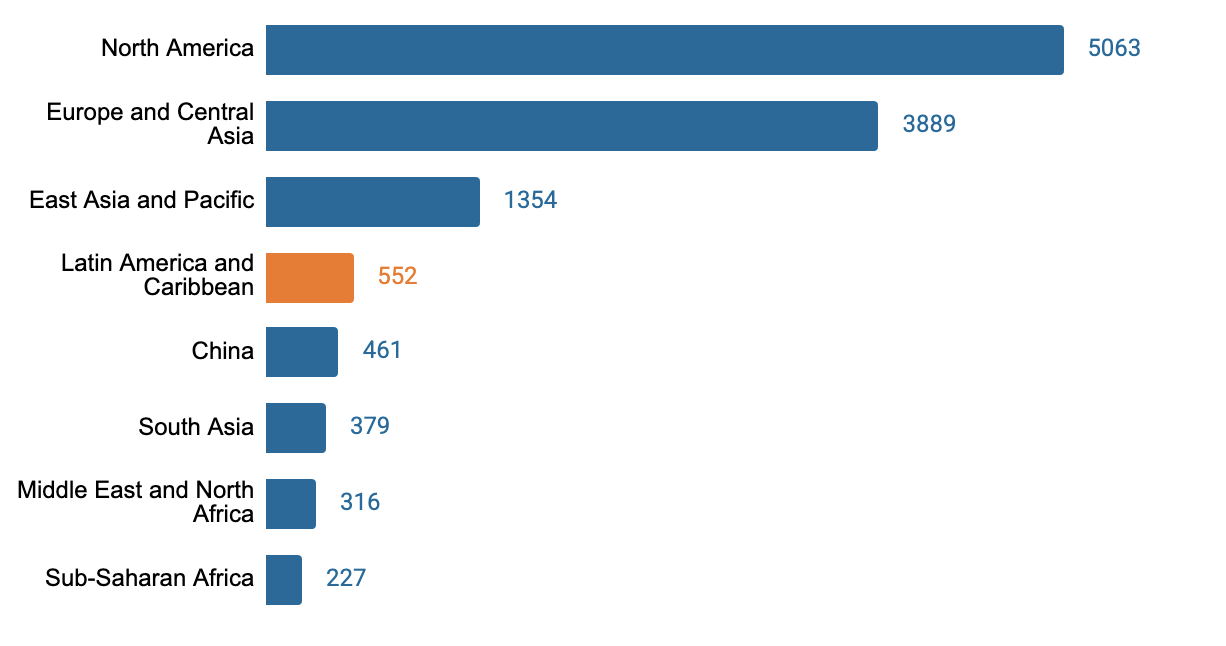
Latin America and the Caribbean has developed a relevant data-center infrastructure base, but its presence remains limited compared with the main global markets. In 2026, the region hosts 552 data centers, considerably fewer than North America, Europe and Central Asia, and East Asia and the Pacific. North America alone hosts more than 5,000 facilities, while Europe and Central Asia has close to 3,900.
Number of data centres by world region
Source: Authors’ elaboration based on Data Center Map data, accessed on 15 August 2026.
The regional comparison reflects the strong global concentration of digital infrastructure. Latin America and the Caribbean has a larger data-center presence than South Asia, the Middle East and North Africa, and Sub-Saharan Africa, but remains well behind the world's principal digital infrastructure hubs.
The availability of data centers matters because these facilities provide the physical basis for data storage, cloud computing and the delivery of digital services. However, the number of facilities alone does not indicate their size, computing capacity or suitability for advanced AI workloads. It should therefore be interpreted as an indicator of the broader digital infrastructure base, rather than as a direct measure of AI computing capacity.
Digital infrastructure is highly concentrated within LAC
Number of data centres per country
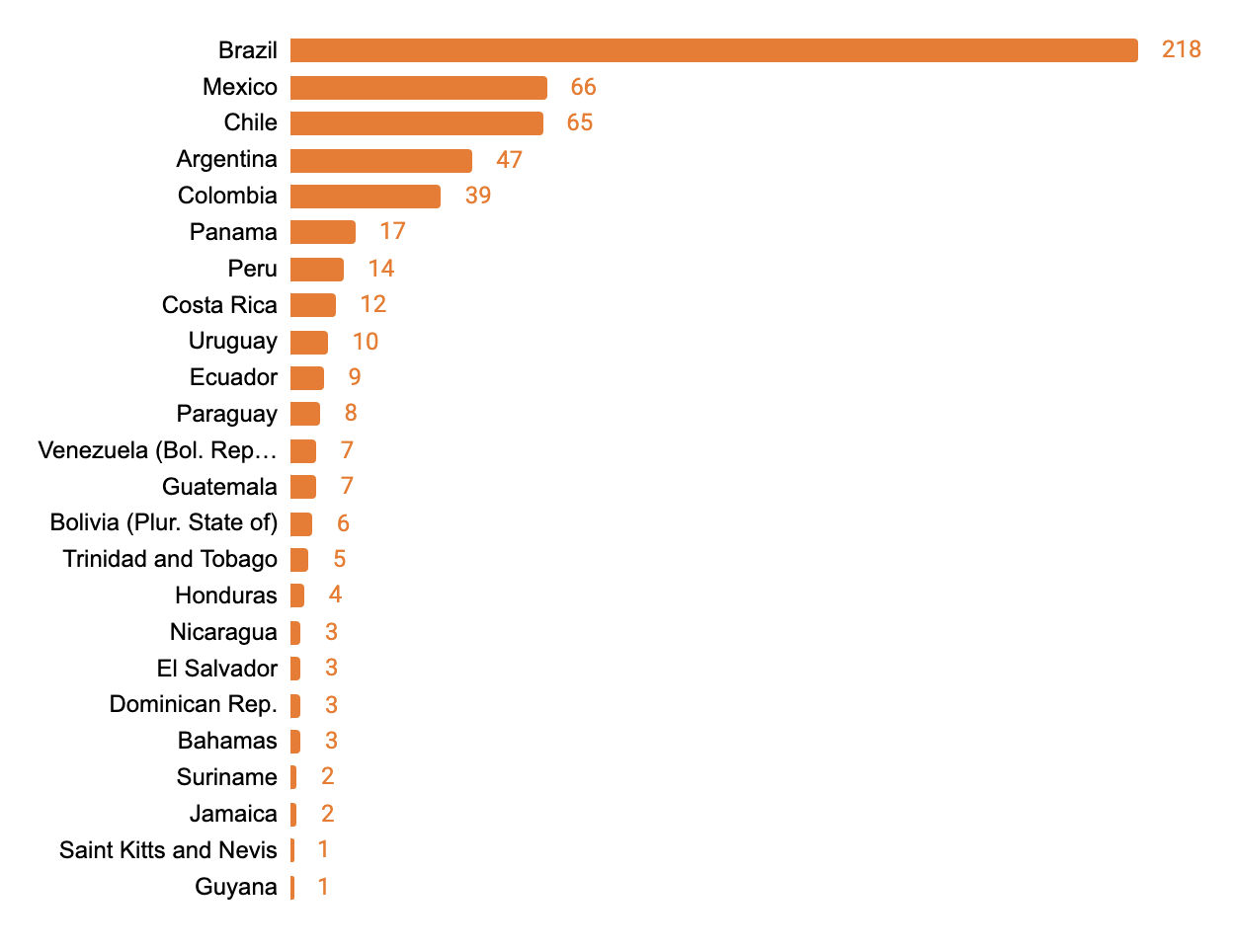
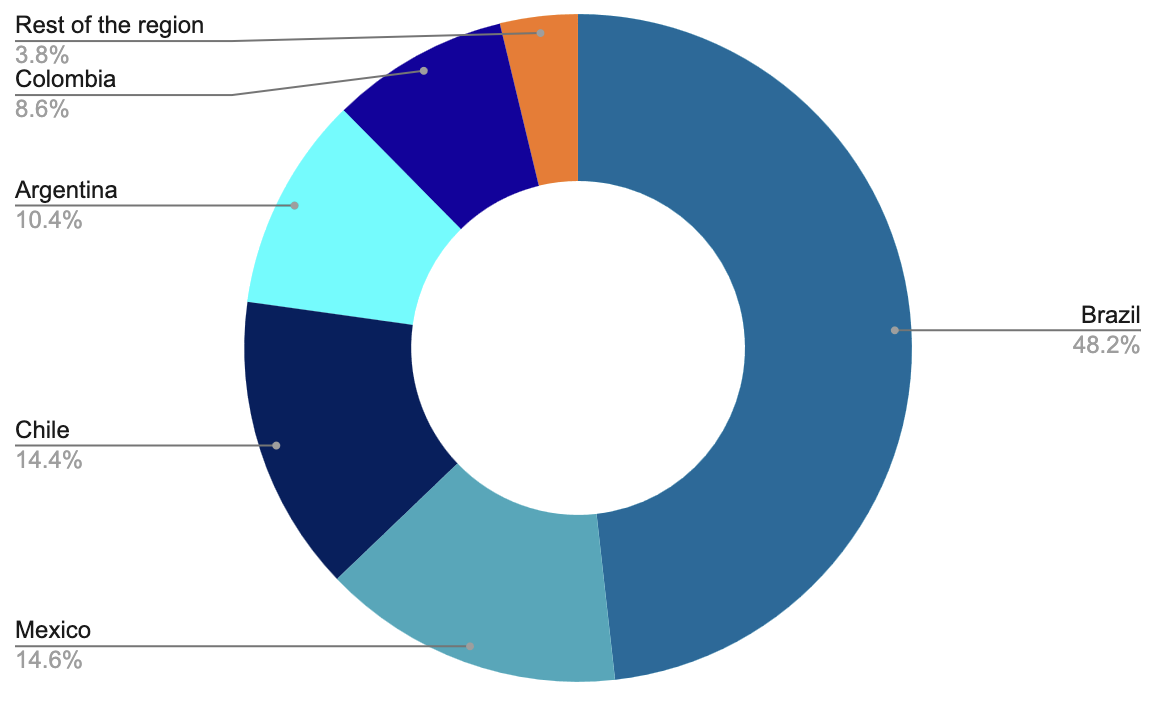
Brazil has by far the largest number of data centers in the region, with 218 facilities, followed by Mexico with 66, Chile with 65, Argentina with 47 and Colombia with 39. Together, these five countries account for approximately 97% of all data centers identified in the region.
Five countries account for 97% of the region’s data centres
Source: Authors’ elaboration based on Data Center Map data, accessed on 15 August 2026.
This concentration highlights a second dimension of the infrastructure gap. In addition to the distance separating Latin America and the Caribbean from the world's major infrastructure markets, substantial differences exist within the region itself. A relatively small group of countries has developed more extensive infrastructure ecosystems, while many others have only a limited local data-center presence.
The differences are particularly relevant as demand for cloud computing, data-intensive applications and AI services increases. Greater local infrastructure can support lower latency, more efficient data processing and the development of domestic digital ecosystems. At the same time, the capacity to participate in more advanced stages of AI development increasingly depends on a more specialized layer of infrastructure: access to high-performance computing and large-scale GPU clusters.
From digital infrastructure to advanced AI computing
The development and deployment of advanced AI systems require computing resources that go substantially beyond conventional digital infrastructure. High-performance GPU clusters and AI-optimized supercomputers enable computationally intensive activities including AI research, model training and the development of advanced AI applications.
Governments are increasingly treating access to this type of infrastructure as a strategic capability. Public and public-private investment in AI supercomputing can expand access for research institutions, government agencies and domestic firms, while reducing dependence on computing infrastructure located abroad. In this context, advanced compute is becoming an important component of debates around technological capacity and digital sovereignty.
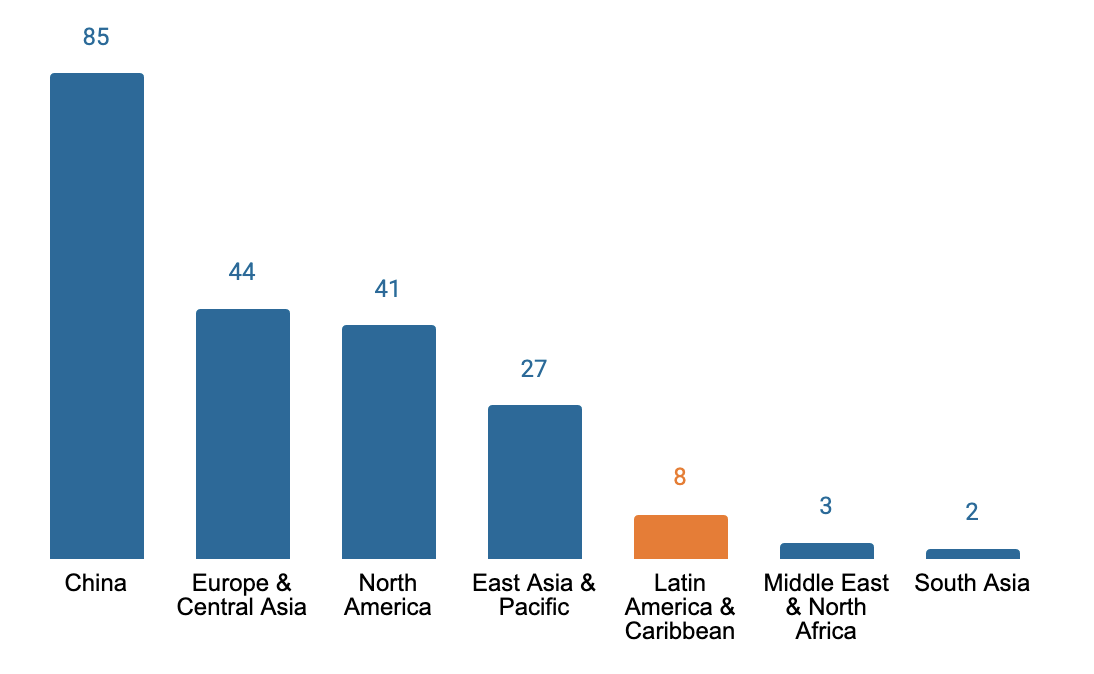
Public or public–private AI supercomputing clusters by region, 2025
Source: Authors’ elaboration based on Epoch AI data cited in Stanford University’s AI Index Report 2026.
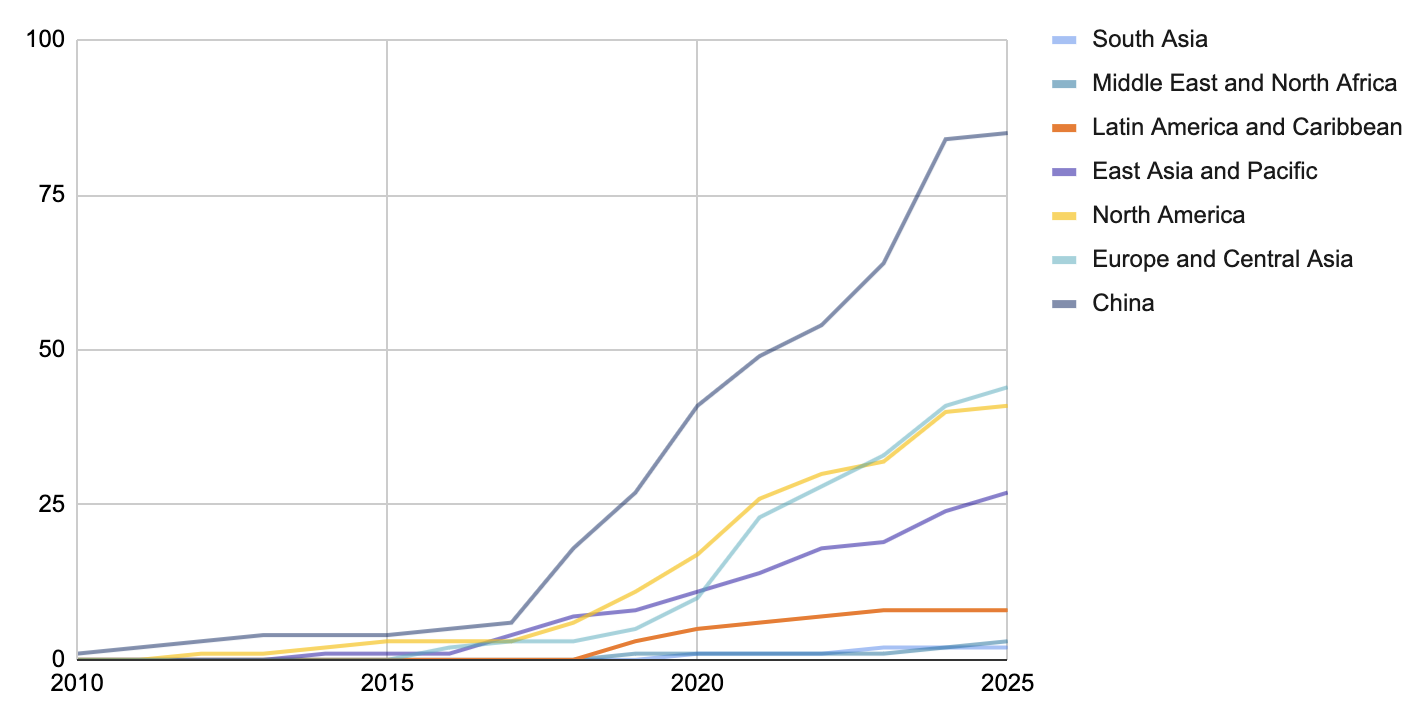
The global distribution of this infrastructure is even more concentrated than that of data centers. In 2025, China had 85 identified public or public-private AI supercomputing clusters, followed by Europe and Central Asia with 44, North America with 41, and East Asia and the Pacific with 27.
Latin America and the Caribbean had eight clusters, equivalent to approximately 4% of the global total. This places the region ahead of the Middle East and North Africa and South Asia, but considerably behind the regions currently leading the expansion of advanced AI computing capacity.
The gap has widened over time
Public and public-private AI supercomputing capacity expanded rapidly after 2018. Latin America and the Caribbean increased from no identified clusters in 2018 to three in 2019, five in 2020 and eight by 2023. However, the number remained at eight between 2023 and 2025.
During the same two-year period:
- East Asia and the Pacific recorded the strongest growth among the major AI computing regions, increasing its number of clusters by 42% between 2023 and 2025.
- Europe and Central Asia expanded its capacity by 33%, rising from 33 to 44 clusters.
- China also grew by 33%, adding 21 clusters over the period.
- North America increased its number of clusters by 28%, from 32 to 41.
The comparison therefore points to a growing challenge. The region has established part of the underlying digital infrastructure required for the AI era, but the transition toward advanced computing capacity is progressing more slowly than in the world's leading AI regions.
Evolution of AI supercomputing clusters, 2018–2025
Source: Authors’ elaboration based on Epoch AI data cited in Stanford University’s AI Index Report 2026.
The comparison therefore points to a growing challenge. The region has established part of the underlying digital infrastructure required for the AI era, but the transition toward advanced computing capacity is progressing more slowly than in the world's leading AI regions.
This distinction is important. Data centers provide an essential foundation for cloud services, data storage and computing, but not all facilities are equipped to support computationally intensive AI workloads. The availability of specialized GPU clusters and AI supercomputers represents a more advanced layer of technological capability.
Strengthening the region's position will therefore require attention not only to the expansion of digital infrastructure, but also to the quality, scale and accessibility of computing resources available for AI. Public investment, public-private partnerships and regional cooperation could play an important role in broadening access to advanced computing capabilities, particularly for universities, research centers, governments and firms that would otherwise face high barriers to entry.
Sources: Data center data from https://www.datacentermap.com/, retrieved 15.8 2026; AI super computer clusters derived from Stanford HAI, AI Index Report 2026, based on Epoch AI data on large-scale GPU clusters.
More data and facts
Connected economy
Digital economy
Indicators list
Related SDG
