


AI can reshape digital priorities in months: how can policies designed to last for years keep pace?
Last updated: 25/11/2026
National digital agendas are drawn up as long-term roadmaps, which is necessary to guide investments and reforms that take years. The problem arises when that horizon far exceeds the pace of technological change. The rise of generative artificial intelligence (AI) since late 2022 has shown how quickly digital policy priorities can shift. The question is how existing instruments adapt.
The survey of the 16 digital agendas in force in Latin America and the Caribbean as at 31 July 2026 shows this tension clearly. The agendas remain in force for eight years on average, but only three, those of Brazil, Dominica and Ecuador, establish an explicit updating mechanism. That period is longer than the term of the governments that published them, and five agendas cover 10 years or more. The agenda of Dominica, for example, provides for a review of the strategy every three years and an annual evaluation of its action plan. Another eight recognize the need for dynamic instruments but do not specify how they will be updated, and the remaining five do not address the issue.
Period of validity of national digital agendas and updating mechanisms, Latin America and the Caribbean, 2026
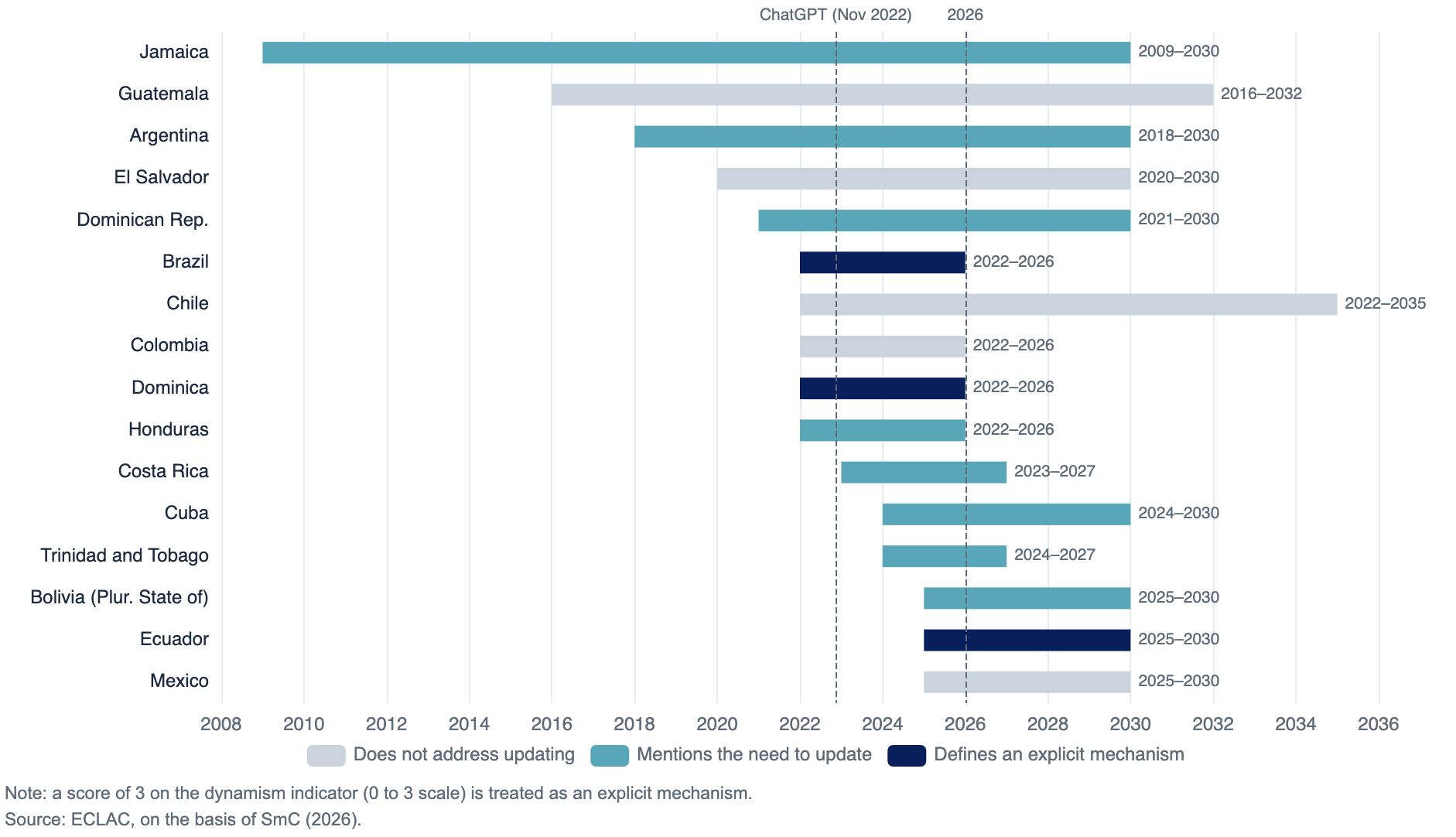
A long horizon is not the problem in itself. The difficulty is that many agendas do not explain how they will adapt while they remain in force. Of the 16 agendas, 11 were published in 2022 or later, but only six postdate the launch of ChatGPT in November of that year. The rest were designed before generative AI expanded, and most do not define how they will be updated. In addition, four agendas, those of Brazil, Colombia, Dominica and Honduras, expire in 2026.
The lack of updating mechanisms weakens the region’s capacity to govern a digital transformation that AI is accelerating. Without them, general frameworks may fall out of step with the technologies they seek to guide. Periodic review cycles, with action plans updated more often than the general framework, would allow agendas to adapt without waiting for them to expire. The expiry of four agendas in 2026 is a concrete opportunity to build this design into the next generation of instruments.
Methodological note: Validity refers to the implementation period declared in each instrument. The dynamism indicator assesses, on a scale from 0 to 3, whether the agenda provides for updating mechanisms and how precisely it defines them. An explicit mechanism is considered to exist when the score is 3. The indicators reflect the content of the documents and not their effective application.
More data and facts
Connected economy
Digital economy
Indicators list
Related SDG
