


From April 2023 to April 2026, visits to the AI tools studied in Latin America and the Caribbean rose by 53%, with text generation alone accounting for more than three-quarters of the increase.
Last updated: 7/11/2026
The use of artificial intelligence solutions in Latin America and the Caribbean has expanded rapidly in recent years. Between April 2023 and April 2026, traffic to the solutions included in the sample increased from approximately 935 million to 1.434 billion visits, representing cumulative growth of close to 53%.
However, this expansion was not evenly distributed across different types of tools. Most of the growth came from generative AI solutions, whose traffic increased by around 60% over the period, from approximately 800 million to more than 1.28 billion visits.
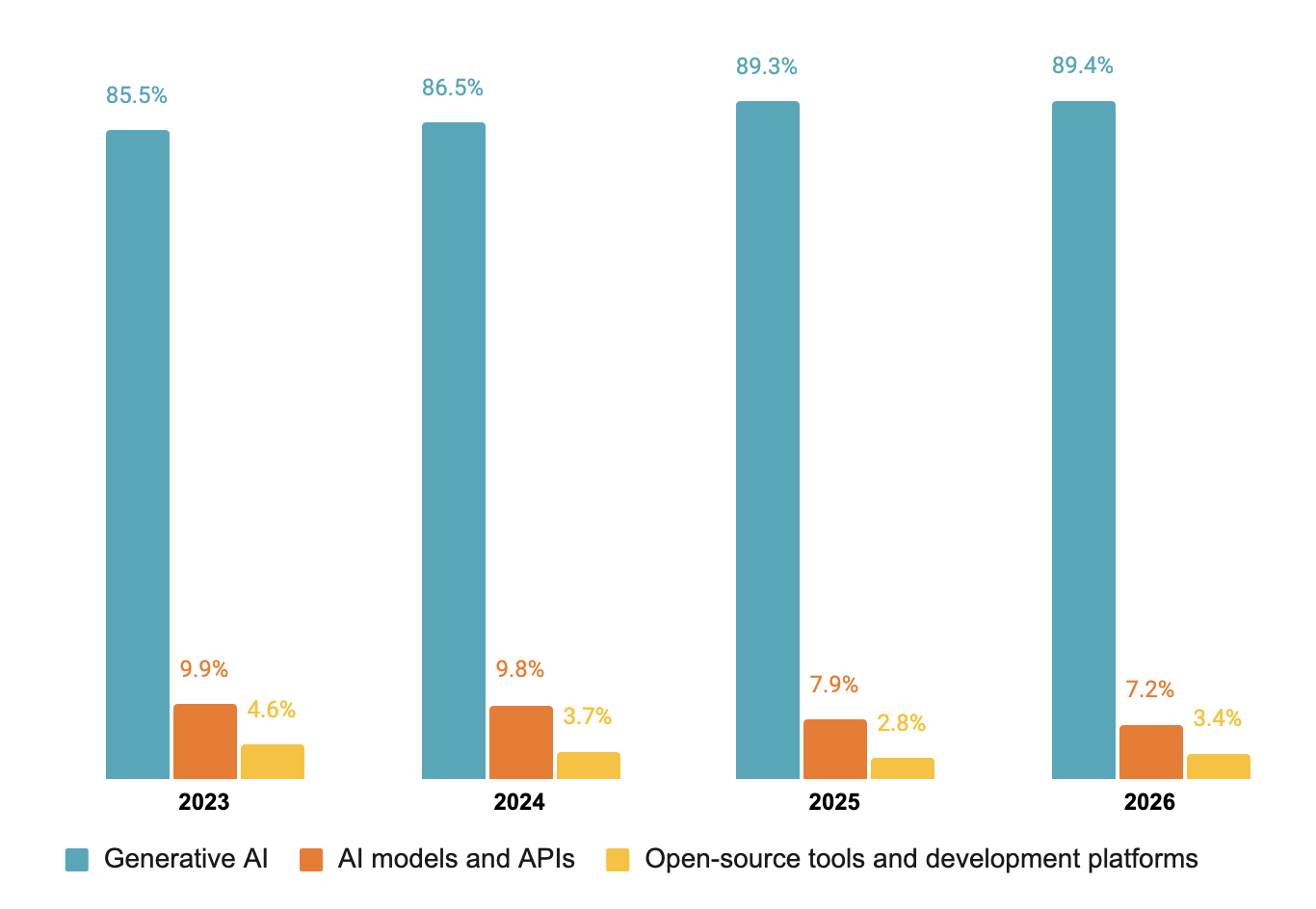
As a result, generative AI’s share of total traffic increased from 85.5% in 2023 to 89.4% in 2026. By contrast, AI models and APIs declined from around 9.9% to 7.2% of traffic, while open-source and development platforms decreased from 4.6% to 3.4%.
Share of web visits to AI tools by technology in Latin America and the Caribbean, April 2023–2026
Source: Author’s own elaboration based on data from RankMyAI and Similarweb.
Growth is concentrated particularly in text generation
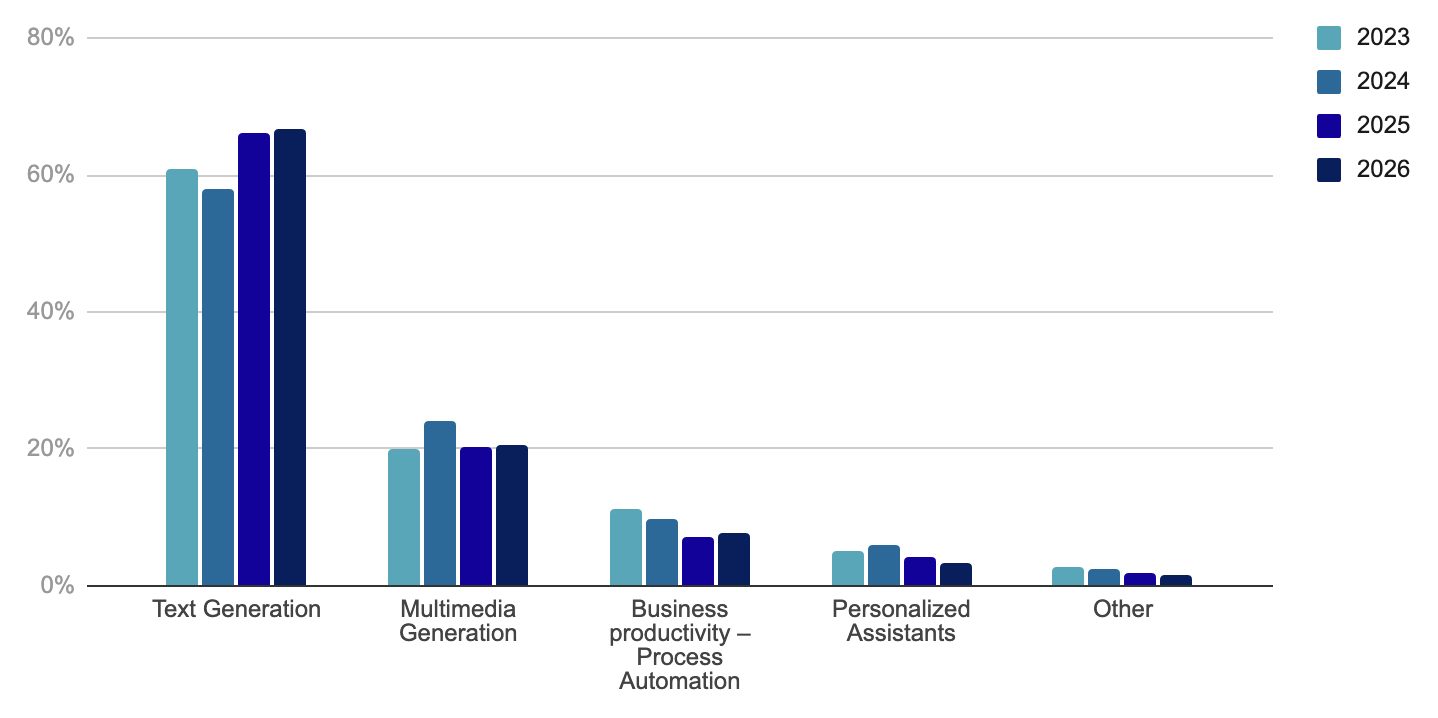
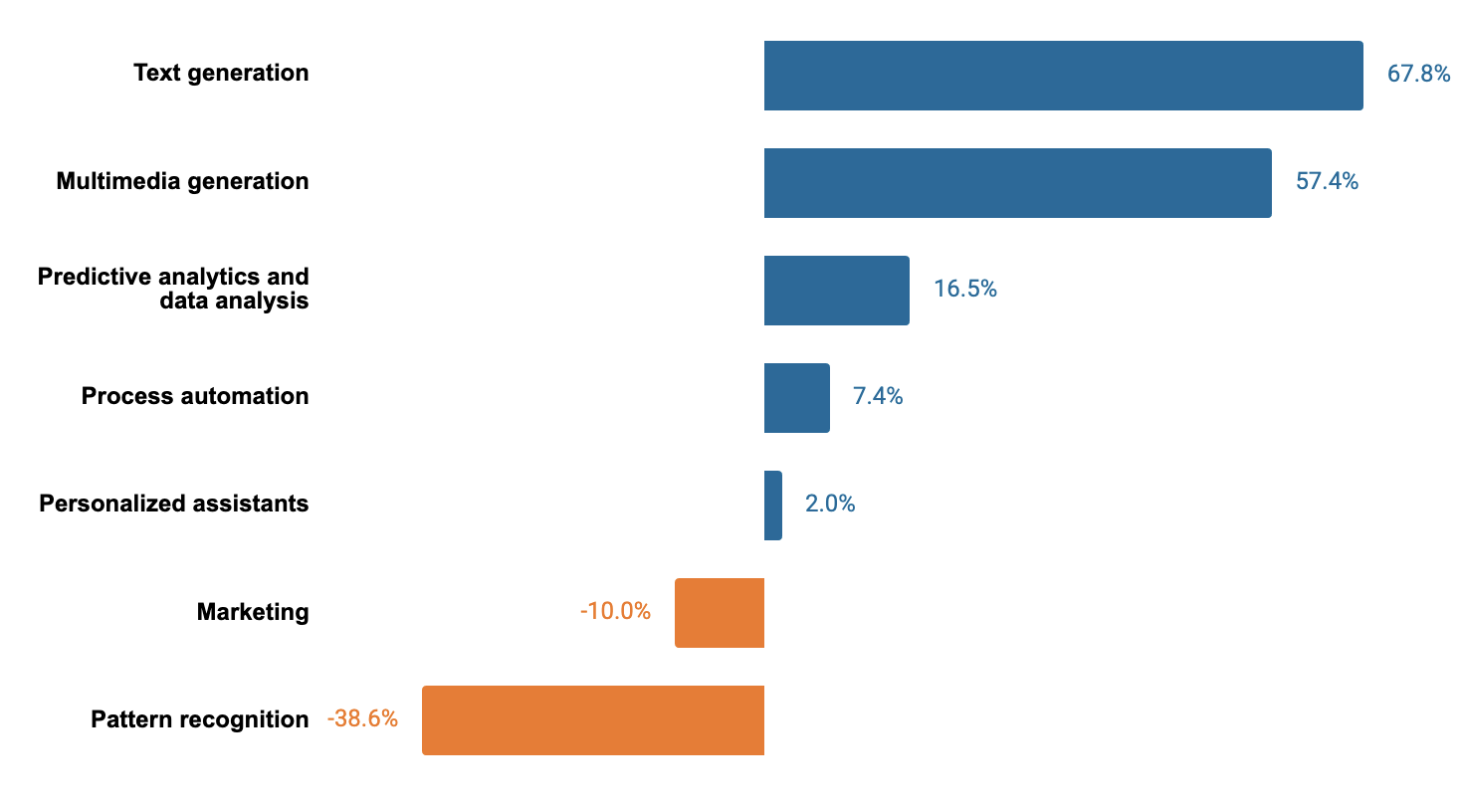
The same trend emerges when solutions are examined by function. Text generation accounted for around 60.9% of total traffic in 2023 and increased to 66.6% in 2026. In absolute terms, visits to these tools grew by close to 68%, from approximately 569 million to 955 million.
Multimedia generation tools also grew significantly, by around 57%, while maintaining a share close to one fifth of total traffic: 20.1% in 2023 and 20.6% in 2026. Together, text and multimedia generation accounted for around 81% of traffic in 2023 and close to 87% in 2026.
This indicates that the recent expansion of AI use in the region has been driven primarily by content-generation applications.
Share of web visits to AI tools by function in Latin America and the Caribbean, April 2023–2026
Source: Author’s own elaboration based on data from RankMyAI and Similarweb.
More traffic does not necessarily imply more diverse uses
Some categories related to business productivity also grew in absolute terms, but at a considerably slower rate than generative AI. Traffic to process automation solutions increased by around 7% between 2023 and 2026, from 104 million to 111 million visits. Because total traffic grew much faster, their share fell from 11.1% to 7.8%.
Personalized assistants show a similar pattern: traffic remained broadly stable at around 49 million visits, but their share of total traffic declined from 5.2% to 3.5%.
Traffic to pattern recognition tools, meanwhile, fell by approximately 39%, while other categories, such as regulatory compliance and recruitment and human resources, recorded high growth rates from very low initial levels and continue to account for only a small fraction of total traffic.
The observed trend therefore suggests that the rapid increase in AI use has so far not been accompanied by a proportional diversification into a broader range of functions.
Growth in traffic to AI solutions by function in Latin America and the Caribbean, 2023–2026 (Only categories with at least 1 million visits in 2023 are included, to avoid high growth rates associated with very small initial bases distorting the comparison.)
Source: Author’s own elaboration based on data from RankMyAI and Similarweb.
Rapid expansion, but an increasingly concentrated structure of use
From a productive-development perspective, this evolution raises an important issue. The growth of generative tools indicates the rapid diffusion of AI solutions accessible to individual users, workers and businesses. These technologies can help reduce the cost of accessing capabilities such as content generation, task assistance and information processing.
However, the increasing concentration of traffic in text and content generation also shows that the diffusion of AI does not automatically translate into more diversified adoption within productive processes. The largest productivity gains associated with artificial intelligence will depend not only on how many people use these tools, but also on the ability of firms and institutions to incorporate them into productive, organizational and decision-making processes.
The pattern observed between 2023 and 2026 suggests that Latin America and the Caribbean is in a phase of rapid expansion in AI use, but one in which directly accessible applications continue to advance faster than other forms of use linked to automation, analysis or solution development.
From diffusion to productive use
The public-policy challenge does not appear to lie only in promoting access to artificial intelligence. The rapid expansion in traffic shows that the available tools are finding demand in the region. The challenge is to turn that diffusion into broader productive capabilities.
This means enabling firms, especially small and medium-sized enterprises, to identify relevant use cases, reorganize processes, develop complementary skills and gain access to the infrastructure, data and services needed to integrate AI more deeply. It also means strengthening the capacity of developers and organizations to use models, APIs and open platforms so that the regional ecosystem does not depend solely on the consumption of finished applications.
Developments over the coming years will show whether the strong initial diffusion of generative AI evolves into a broader phase of productive integration, or whether use remains concentrated mainly in a limited set of end-user applications.
Methodological note: The analysis uses web traffic to artificial intelligence solution websites as a proxy for adoption. Traffic data come from Similarweb, while the identification and classification of AI solutions are based on RankMyAI. The series compares traffic recorded in April 2023, April 2024, April 2025 and April 2026 for a comparable sample of AI solutions. Solutions are classified both by the technology that enables them — generative AI, AI models and APIs, and open-source and development platforms — and by their main function. The methodology makes it possible to analyse changes in the use of solutions accessible via the Internet, but it does not capture the full extent of AI adoption. In particular, enterprise implementations operating in internal systems, private networks or back-end environments may not generate observable web traffic and may therefore be underrepresented.
More data and facts
Connected economy
Digital economy
Indicators list
Related SDG
