



The educational technology business landscape is uneven: Brazil alone hosts more than half of the region’s registered active EdTech companies.
Last updated: 25/11/2026
Educational technology companies, known as EdTech firms, offer tools for learning, training and the management of educational institutions. Crunchbase data collected around August 2026 provide a snapshot of these active businesses, their geographical distribution and their foundation years. The picture combines strong geographical concentration with fewer companies belonging to recent founding cohorts.
The region did not replicate the global rise in the 2020 founding cohort
Among the companies still active at the time of consultation, 925 worldwide were founded in 2020, compared with 755 in 2019, a difference of 22.5%. In Latin America and the Caribbean, the corresponding figures were almost unchanged: 55 companies founded in 2020 and 56 in 2019.
The region’s subsequent founding cohorts are smaller. The database records 32 active companies founded in 2021, 33 in 2022 and 15 in 2023. Together, these three years account for 80 companies, compared with 152 founded between 2017 and 2019. The annual average falls from approximately 51 to 27 companies, a difference of 47%.
Active EdTech companies by founding year, worldwide and in Latin America and the Caribbean, 2010–2025 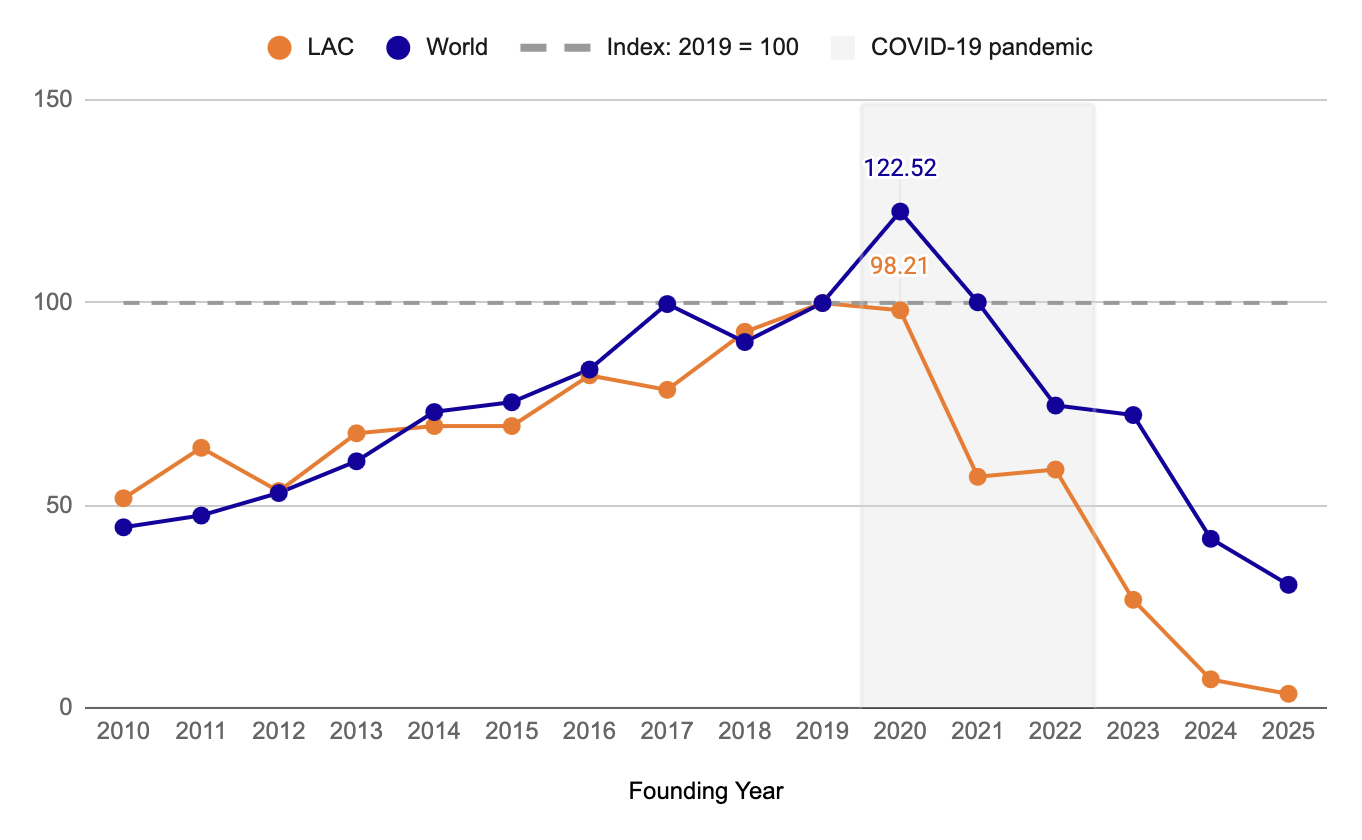
Fuente: Elaboración propia sobre la base de Crunchbase.
The 2024 and 2025 cohorts are smaller still. However, recent years require particular caution because newly founded companies may take time to appear in the database. These figures describe the foundation years of businesses active at the time of consultation. They do not measure all businesses historically created or establish how sales, investment or the use of digital education solutions have evolved.
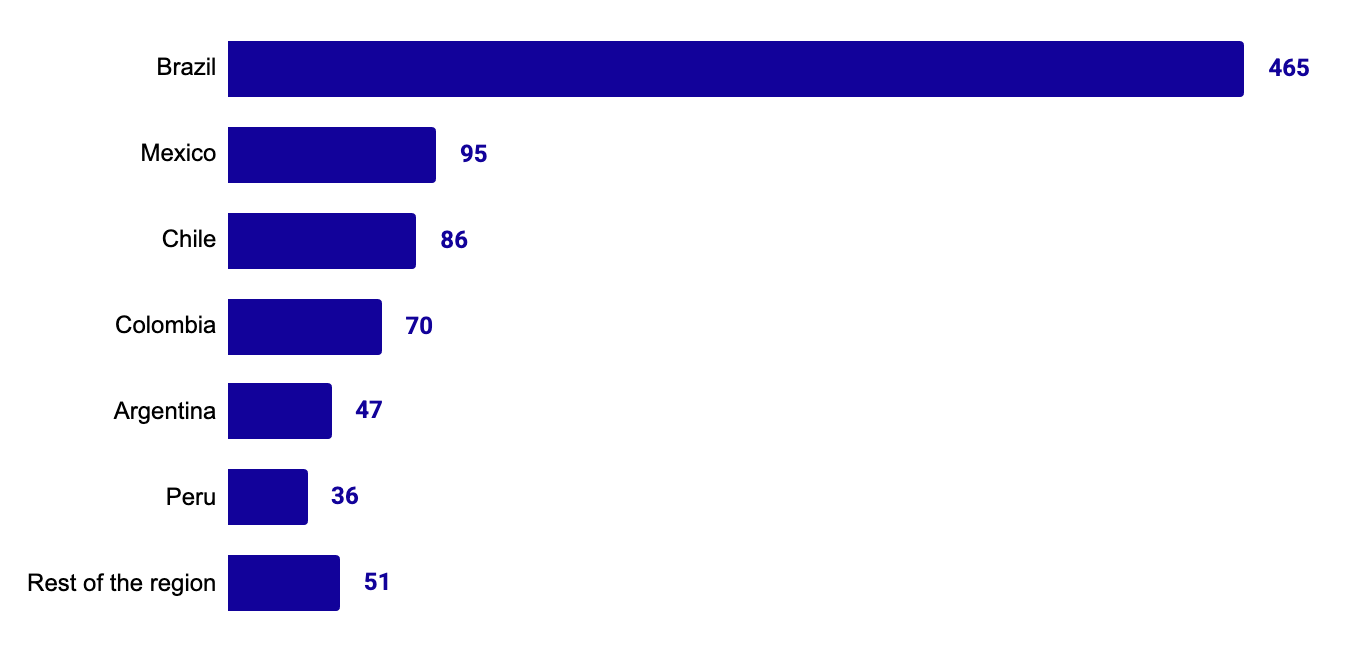
Four countries account for 84% of the regional ecosystem
The database identifies 850 active EdTech companies in Latin America and the Caribbean, representing 5.1% of the 16,617 recorded worldwide. Their distribution within the region is highly uneven. Brazil accounts for 465 companies, or 54.7% of the regional total. It is followed by Mexico with 95, Chile with 86 and Colombia with 70. Together, these four countries account for 84.2% of the companies identified, while Argentina and Peru host a further 47 and 36, respectively.
Distribution of active EdTech companies in Latin America and the Caribbean, 2026 (Number of companies.)
Fuente: Elaboración propia sobre la base de Crunchbase.
Most of these businesses have relatively few employees. Among the 814 regional companies with employment information, 87.7% have between 1 and 50 employees, and half have between 1 and 10. Only 22 have more than 250 employees.
The data therefore describe an ecosystem concentrated in a small number of countries and composed mainly of small businesses, with fewer active companies founded in recent years. Assessing its development will require additional information on business growth, continuity and educational reach. Company counts help describe the supply of educational technology, but do not establish how many students use these solutions or their effects on learning.
Methodological note: The data cover active EdTech companies registered in Crunchbase, consulted around August 2026. The founding-year series groups these companies by foundation year and does not represent the total number of businesses historically created. Recent years may be affected by registration delays. Company-size percentages are calculated using the 814 regional businesses with employment information.
More data and facts
Connected economy
Digital economy
Indicators list
Related SDG

