



AI depends on connectivity, infrastructure and data, yet its policies risk moving ahead without alignment with the framework that brings these capabilities together.
Last updated: 25/11/2026
National digital agendas are, in principle, the general framework for digital transformation policies. More specific instruments, such as artificial intelligence (AI) strategies, are expected to derive from them. However, the rapid advance of AI is partly reversing this relationship. In several countries of Latin America and the Caribbean, AI strategies are now more developed and detailed than the agendas that should frame them.
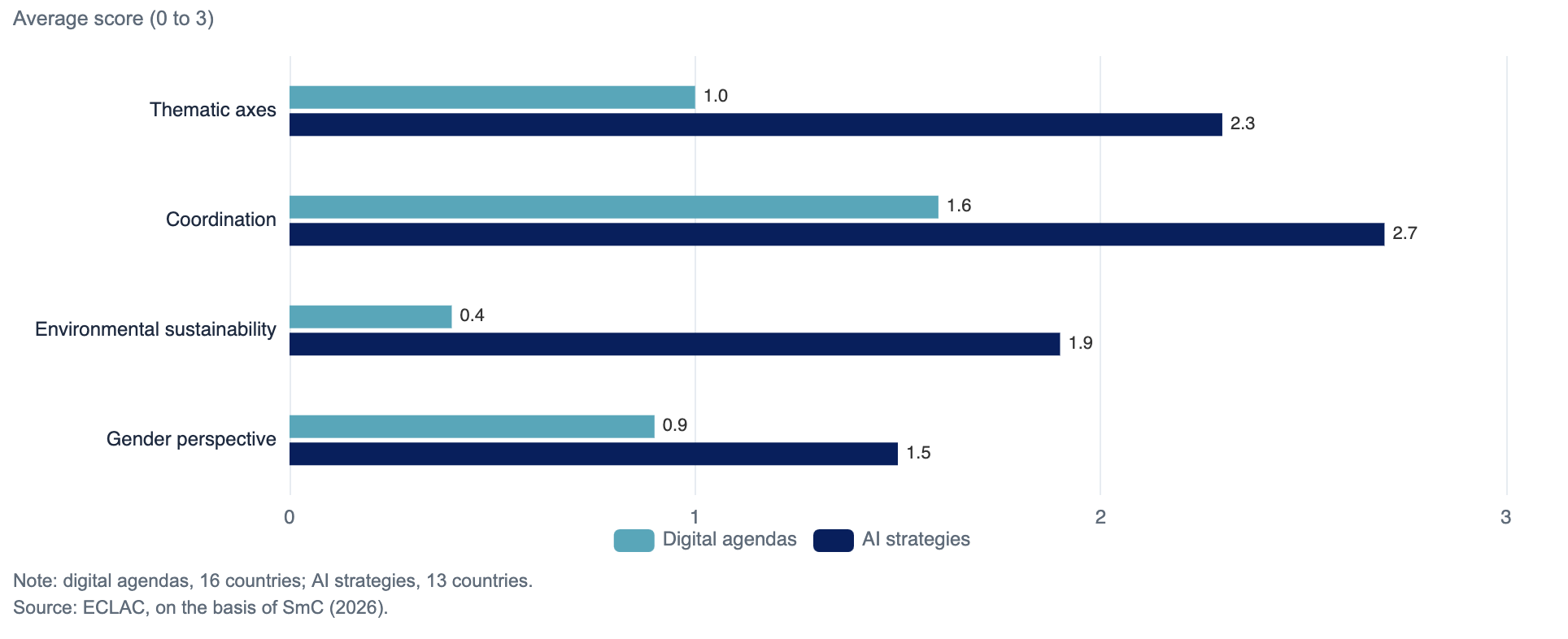
A survey of 51 instruments in force in 20 countries of the region, conducted for ECLAC with information as at 31 July 2026, makes it possible to measure this gap. The scale ranges from 0 (omission) to 3 (institutionalization with targets, timelines or budget). The 13 national AI strategies average 2.3 points on their thematic axes, while the 16 digital agendas average 1.0. The gap recurs in implementation mechanisms, such as coordination (2.7 compared with 1.6). It also appears in the cross-cutting approaches of environmental sustainability (1.9 compared with 0.4) and gender perspective (1.5 compared with 0.9).
Average score of digital agendas and national AI strategies in selected dimensions, Latin America and the Caribbean, 2026
The result runs counter to the expected sequence. The agendas, designed to guide digital policy as a whole, address AI only to a limited extent. Although 14 of the 16 mention it, this area averages just 0.5 points. Only three agendas, those of Costa Rica, Cuba, and Trinidad and Tobago, propose designing a national AI strategy. Three others, those of Bolivia, Chile and the Dominican Republic, include actions for its use in productive sectors. The specific instrument has thus moved further than the framework meant to guide it.
This gap raises a coherence problem. AI policies can advance without being integrated into the wider digital strategy. That strategy is what brings together the connectivity, infrastructure, skills and data governance on which AI itself depends. This weakens the region’s capacity to govern AI, because decisions on this technology may be taken apart from the rest of digital policy. Building AI into the design of digital agendas, and aligning the objectives and timelines of both instruments, would allow these policies to move forward in a coordinated way.
Methodological note: Scores were assigned on a scale from 0 (omission) to 3 (institutionalization with quantifiable targets, timelines or budget), on the basis of the content of the official documents in force as of 31 July 2026. The analysis covered the digital agendas of 16 countries and the AI strategies of 13 countries. The indicators reflect the design of the instruments and do not allow for an assessment of their implementation.
More data and facts
Connected economy
Digital economy
Indicators list
Related SDG
