


Data crosses borders to power AI, yet none of the 16 digital agendas analysed sets out how to govern those flows.
Last updated: 25/11/2026
Artificial intelligence (AI) and cloud services depend on where data are stored, processed and transferred. Rules on the movement of data between countries have therefore become a central element of digital governance. The issue is more pressing now that Latin America and the Caribbean is discussing the installation of data centres and computing capacity for AI. Where this infrastructure is located also determines which jurisdiction the data fall under.
The region’s digital agendas do address several data governance topics. Digital governance and security is the third most covered area, with an average of 1.2 out of 3. Of the 16 agendas in force, 14 cover cybersecurity in their axes or objectives, 12 open data and 11 personal data protection. However, cross-border data flows are the only indicator in the entire survey with a score of zero in all 16 agendas. None of them sets objectives or guidelines on the issue.
Digital agendas that address data governance topics, Latin America and the Caribbean, 2026
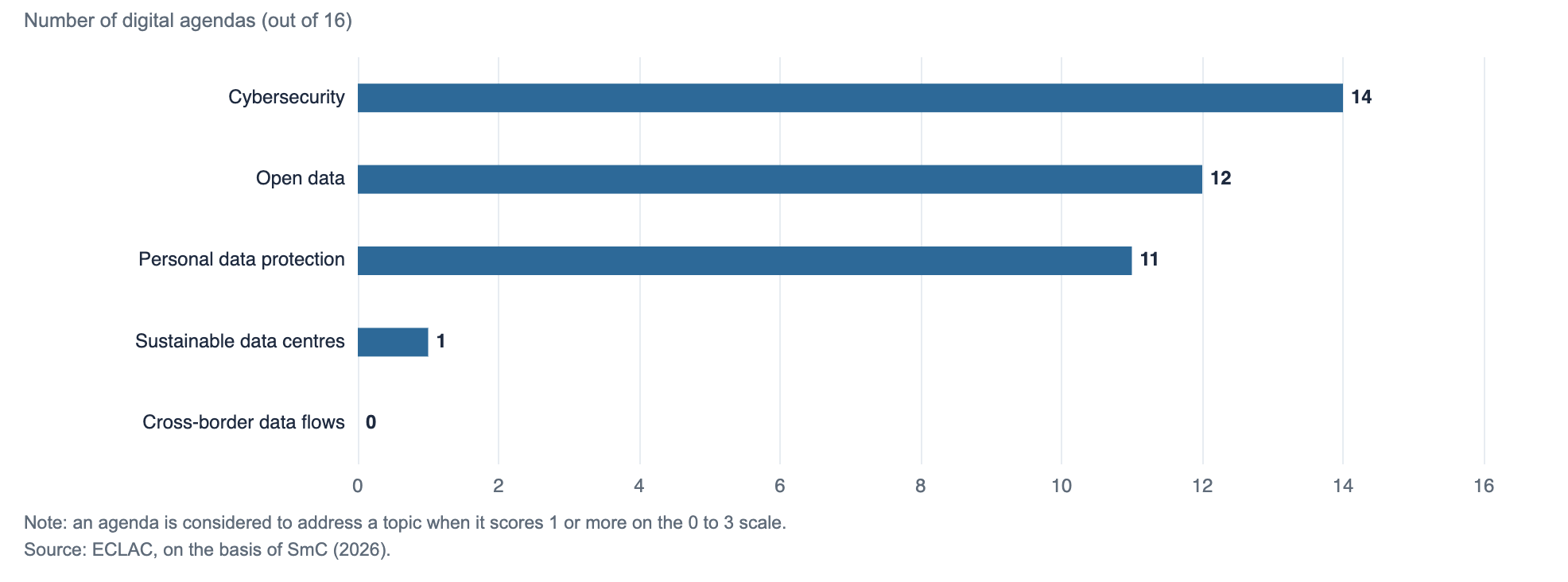
The contrast reveals a specific gap. The agendas deal with protecting data within each country and making them available to the public, but they do not define the conditions under which data may leave the country. The indicator measures what the instruments state, without assessing how data actually circulate. The omission coincides with other shortfalls in the same area. In the agendas, only Mexico records actions on sustainable data centres, and environmental sustainability averages 0.4 out of 3. National AI strategies score higher in that area, at 1.9 on average, although the survey does not include a specific indicator on data flows for them.
As investment in data centres and AI grows, countries will need clearer rules on how, and under what conditions, data can move across borders. Setting these rules before infrastructure decisions are consolidated is simpler than doing so afterwards. It is also a condition for the region to govern the expansion of AI. Building cross-border data flows into digital agendas, and coordinating these criteria at the regional level, would give new computing infrastructure legal certainty. It would also protect the people and firms whose data are involved.
Methodological note: An agenda is considered to address a topic when it obtains a score of 1 or more on a scale from 0 (omission) to 3 (institutionalization). Cross-border data flows were assessed as a sub-indicator of the digital governance and security area. The indicators reflect the design of the instruments and not their implementation.
More data and facts
Connected economy
Digital economy
Indicators list
Related SDG