



Sector matters: 36% of ICT businesses in Latin America use AI, eight times the rate in construction.
Last updated: 23/11/2026
Artificial intelligence adoption is progressing unevenly across economic sectors. These differences may reflect varying levels of digitalisation, technological capabilities and opportunities to integrate AI tools into production and organisational processes.
In Latin America and the Caribbean, the highest estimated adoption rates among the sectors shown are found in information and communication and in professional, scientific and technical services.
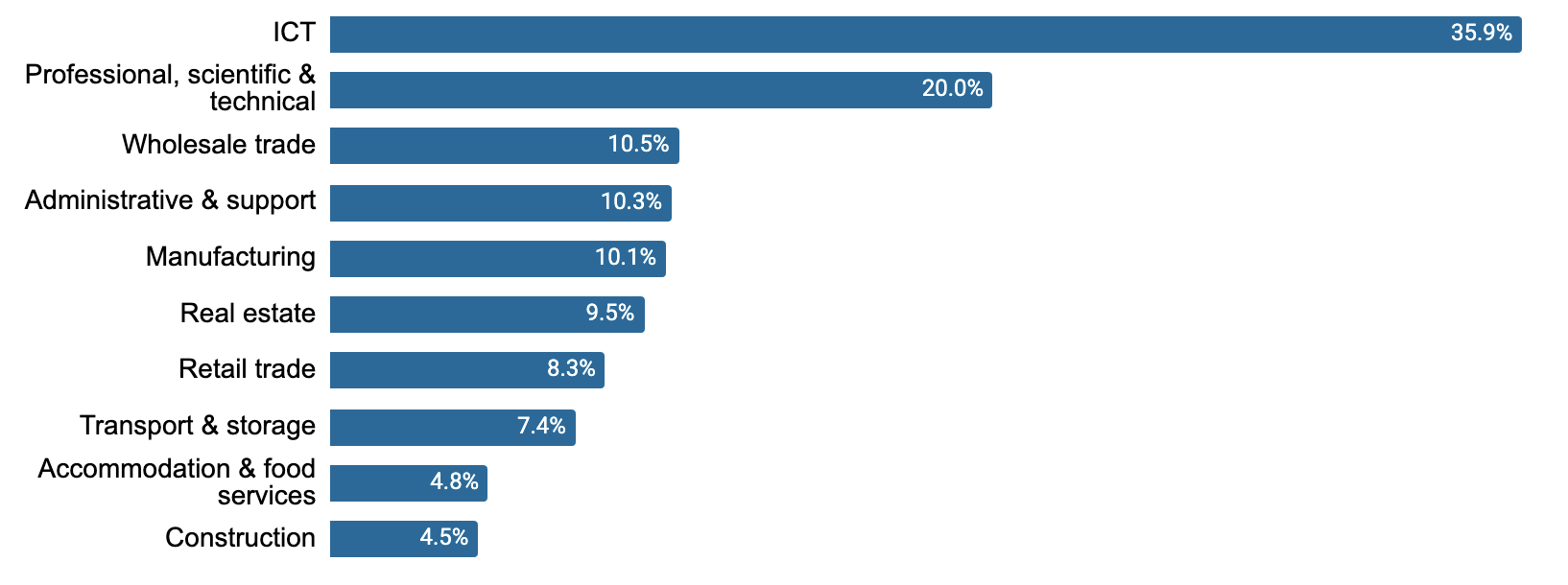
Average AI adoption by sector in Latin America and the Caribbean, 2025
Source: Authors’ own elaboration based on Jung and Katz (2026) and OECD, ICT Access and Usage by Businesses.
Among the sectors shown, information and communication technologies (ICT) has the highest estimated AI adoption rate in the region, at 35.9% of businesses, followed by professional, scientific and technical services at 20.0%. Wholesale trade, administrative and support services, manufacturing and real estate activities form a second group, with adoption rates close to 10%.
Adoption is considerably lower in transportation and storage, accommodation and food services, and construction. Construction records the lowest estimated average among the sectors analysed, at 4.5%.
Sectoral differences are also apparent when comparing Latin America and the Caribbean with the OECD benchmark.
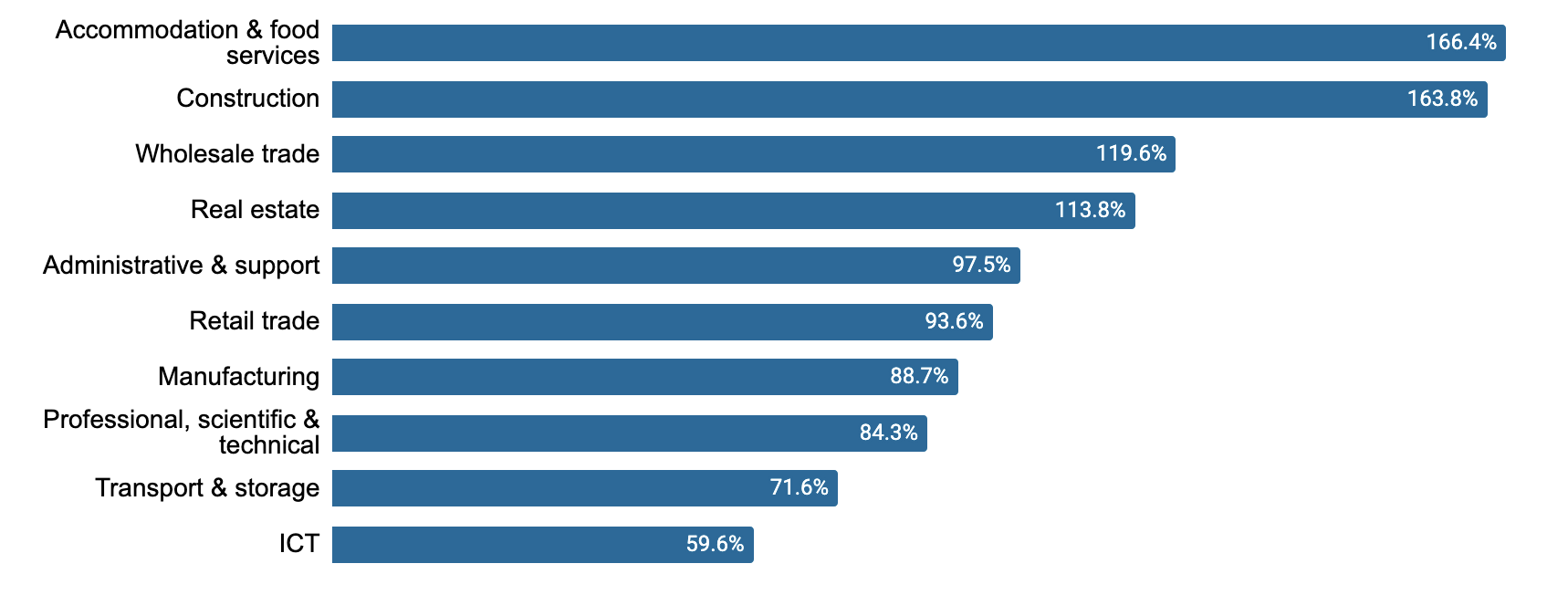
Relative AI adoption gap between the OECD and Latin America and the Caribbean, by sector, 2025
The relative gap is calculated as the OECD adoption rate minus the regional rate, divided by the regional rate and multiplied by 100.
Source: Authors’ own elaboration based on Jung and Katz (2026) and OECD, ICT Access and Usage by Businesses.
Differences relative to the OECD vary considerably across sectors. ICT has the smallest relative gap, at 59.6%, followed by transportation and storage at 71.6%. Professional, scientific and technical services and manufacturing record gaps of 84.3% and 88.7%, respectively.
The largest gaps occur in accommodation and food services and in construction, where OECD adoption rates are more than 160% higher than the estimates for Latin America and the Caribbean. These are also the two sectors with the lowest adoption rates in the region among those analysed.
The results show substantial differences in AI adoption across sectors. These may be associated with digital capabilities, talent availability and opportunities to apply AI, although the charts cannot establish the contribution of each factor. A smaller relative gap does not necessarily imply high adoption: transportation and storage combines a regional adoption rate of 7.4% with the second-smallest gap relative to the OECD.
The productive transformation associated with AI is therefore uneven. Accelerating its diffusion will require particular attention to sectors with more limited digital capabilities, supporting both access to technology and the skills needed to integrate it effectively into business processes, tasks and decisions.
Methodological note: The values for Latin America correspond to estimates of AI adoption obtained using the econometric model developed in the study Adoption of Artificial Intelligence in Firms in Latin America and the Caribbean (Jung and Katz, 2026). The regional average is the simple mean of the 21 countries included. The figures cover ten sectors and exclude financial and insurance activities. For OECD countries, the indicator on enterprises using AI from the OECD’s ICT Access and Usage by Businesses database is used.
More data and facts
Connected economy
Digital economy
Indicators list
Related SDG
