



In Latin America and the Caribbean, large firms adopt AI at roughly four times the rate of small firms.
Last updated: 23/11/2026
Firm size is one of the main factors shaping artificial intelligence adoption. Larger firms generally have greater financial and technological resources, specialized staff and a stronger capacity to reorganize processes and introduce new digital tools. In Latin America and the Caribbean, these differences are clearly reflected in estimated AI adoption rates.
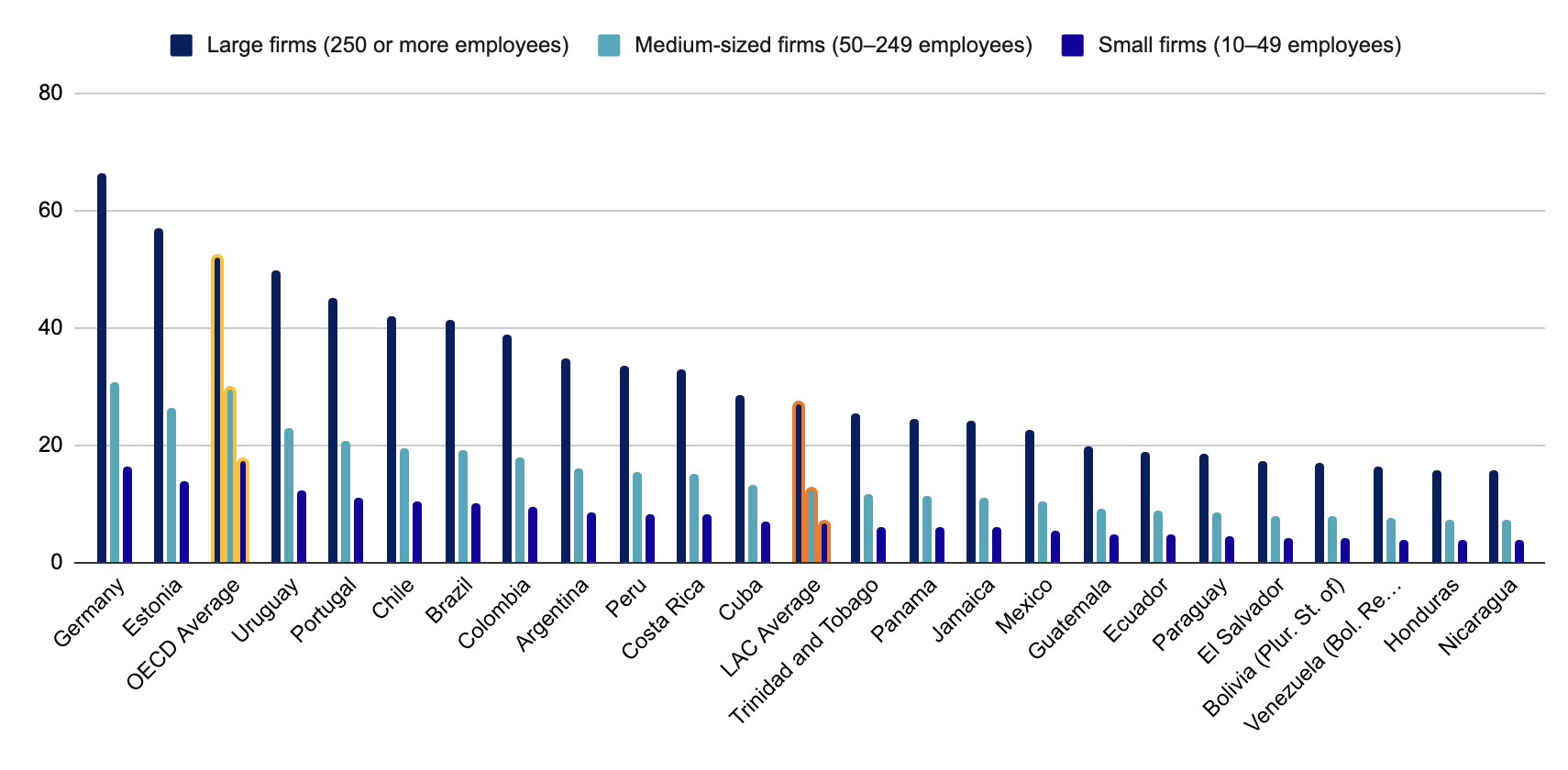
Business adoption of artificial intelligence by firm size, selected Latin American and Caribbean and OECD countries, 2025
Source: Own calculations based on Jung and Katz (2026) and the OECD’s ICT Access and Usage by Businesses database.
In every country analysed, adoption increases with firm size. However, substantial differences exist both between Latin America and the Caribbean and the OECD and within the region itself. Uruguay, Chile and Brazil have the highest adoption rates among the Latin American and Caribbean countries shown, while Honduras, Venezuela and Nicaragua are among those with the lowest estimated rates. Among large firms, Uruguay reaches an estimated adoption rate of 49.8%, close to the OECD average of 52.0%, while Chile and Brazil record 42.1% and 41.4%, respectively.
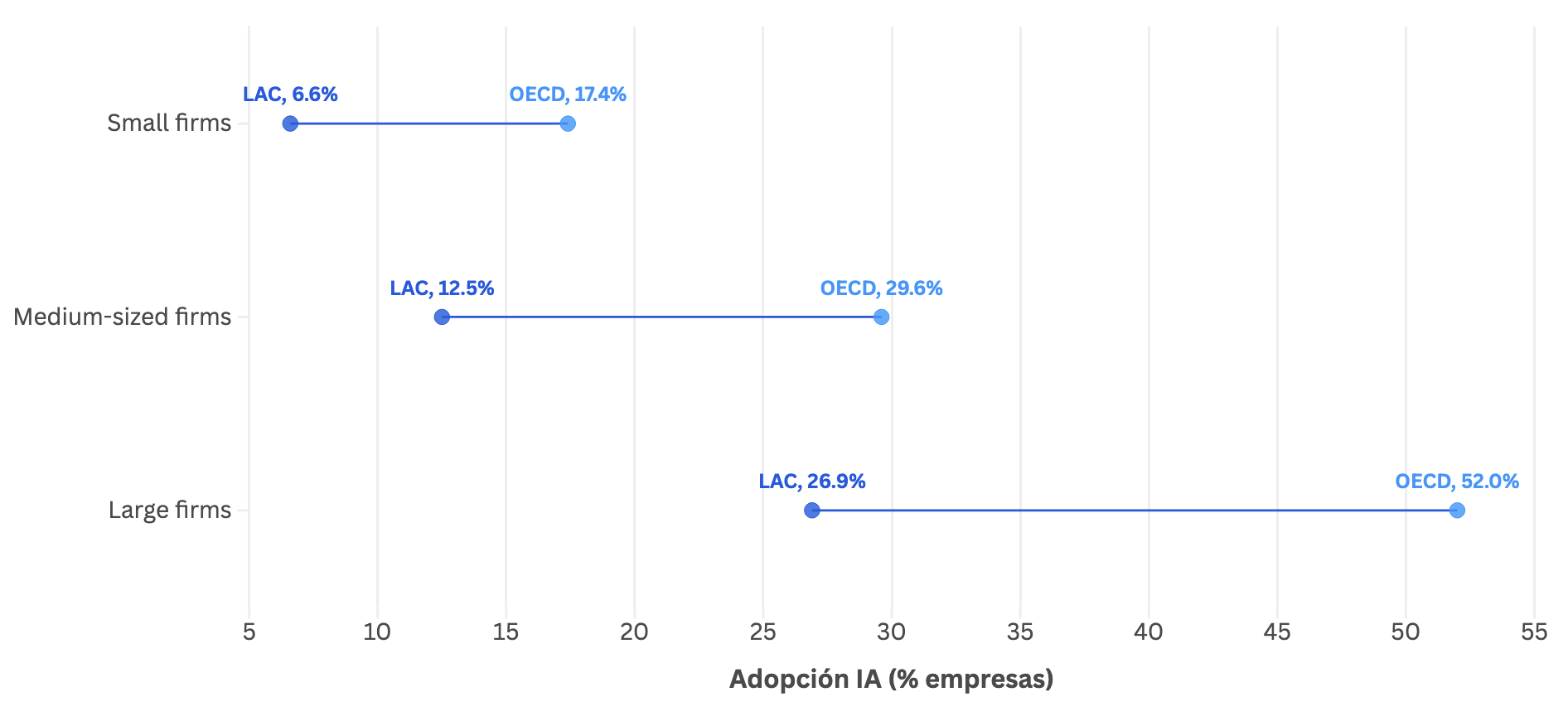
Differences by firm size are also evident in the regional averages. Estimated adoption in Latin America and the Caribbean reaches 6.6% among small firms, 12.5% among medium-sized firms and 26.9% among large firms. The corresponding OECD figures are 17.4%, 29.6% and 52.0%.
Average AI adoption and adoption gaps by firm size, Latin America and the Caribbean and the OECD, 2025
Source: Own calculations based on Jung and Katz (2026) and the OECD’s ICT Access and Usage by Businesses database.
In absolute terms, the gap increases with firm size, reaching 10.8 percentage points among small firms, 17.1 points among medium-sized firms and 25.1 points among large firms. In relative terms, however, the pattern is reversed. Based on the rates shown, OECD adoption is approximately 164% higher among small firms, 137% higher among medium-sized firms and 93% higher among large firms. Large firms in Latin America and the Caribbean are therefore proportionally closer to the levels recorded in the comparison group.
These findings suggest that business adoption of AI is advancing at different speeds within Latin America and the Caribbean. Large firms have more favourable conditions for incorporating new technologies and, in many cases, belong to multinational groups or global production chains that facilitate access to technology and knowledge. Small and medium-sized firms face greater constraints in resources, capabilities and access to specialized expertise.
Narrowing this gap will require policies that help smaller firms access AI tools, technical capabilities, training and support services to integrate these technologies into their production and management processes.
Methodological note: The values for Latin America correspond to estimates of AI adoption obtained using the econometric model developed in the study Adopción de la inteligencia artificial en empresas de América Latina y el Caribe (Jung and Katz, 2026). For OECD countries, the analysis uses the indicator measuring businesses that use AI from the OECD’s ICT Access and Usage by Businesses database, based on official surveys of digital technology use among businesses with 10 or more employees. Official OECD data for 2025 are unavailable for Chile, Mexico, Colombia and Costa Rica, so model estimates are used to maintain regional comparability.
More data and facts
Connected economy
Digital economy
Indicators list
Related SDG
