



Between 2020 and 2025, business adoption of AI in Latin America and the Caribbean more than doubled, yet the gap with the OECD comparison group widened fivefold.
Last revision date: 23/11/2026
Business adoption of artificial intelligence is a key factor in translating technological advances into improvements in productivity, innovation and new business models. However, its diffusion remains uneven across countries and regions.
Comparable statistics on AI use by businesses remain limited in Latin America and the Caribbean. To address this information gap, adoption levels were estimated for 20 countries in the region using an econometric model and compared with available data for OECD countries.
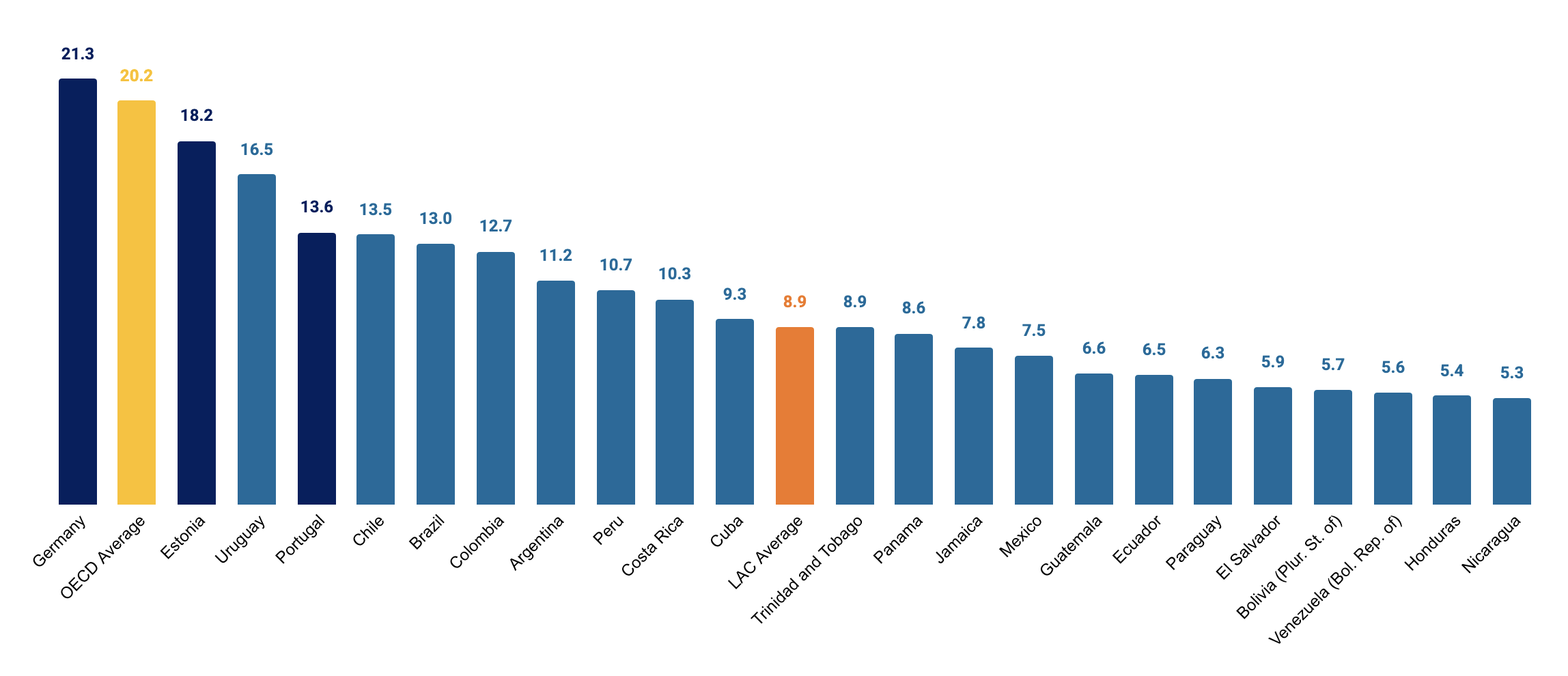
Figure 1. Business adoption of artificial intelligence, selected Latin American and Caribbean and OECD countries, 2025
 Source: Own calculations based on Jung and Katz (2026) and the OECD’s ICT Access and Usage by Businesses database.
In 2025, estimated average AI adoption among businesses in Latin America and the Caribbean reaches 8.9%, less than half the 20.2% average recorded for the OECD comparison group.
There are substantial differences within the region. Uruguay has the highest adoption rate at 16.5%, followed by Chile (13.5%), Brazil (13.0%) and Colombia (12.7%). These countries approach the levels observed in some OECD economies, although they remain below the group average. At the other end of the spectrum, several countries in the region have estimated adoption rates below 6%.
Comparison with selected OECD countries puts this gap into perspective. Even the Latin American and Caribbean countries with the highest adoption rates fall below the OECD average. Adoption exceeds 40% in Finland, Sweden and Denmark, while Singapore, an additional comparator outside the OECD, reaches 66.1%. These figures indicate that AI diffusion across the region’s business sector remains at a relatively early stage.
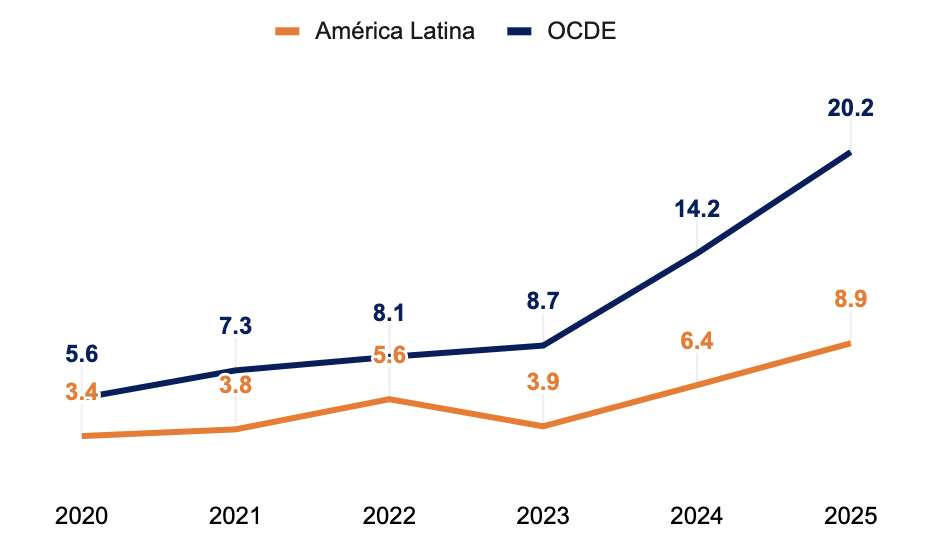
Figure 2. Trends in average business adoption of artificial intelligence, Latin America and the Caribbean and the OECD, 2020–2025
Source: Own calculations based on Jung and Katz (2026) and the OECD’s ICT Access and Usage by Businesses database.
Between 2020 and 2025, AI adoption increased in both groups, with faster growth in the OECD. Estimated average adoption in Latin America and the Caribbean rose from 3.4% to 8.9%, while the average for the OECD comparison group increased from 5.6% to 20.2%.
The absolute gap between the two groups increased from 2.3 percentage points in 2020 to 11.3 points in 2025. Although adoption increased in Latin America and the Caribbean, the distance from the comparison group widened by 9.1 percentage points over the period.
This trend presents a challenge for the region’s productive transformation. As AI becomes integrated into a growing number of business processes, slower diffusion could widen existing differences in productivity, innovation and competitiveness. Accelerating adoption will require broader access to technologies alongside stronger business capabilities to incorporate them effectively into processes, organizational practices and decision-making.
Methodological note: The values for Latin America are estimates of AI adoption obtained using the econometric model developed in the study Adopción de la inteligencia artificial en empresas de América Latina y el Caribe (Jung and Katz, 2026). For OECD countries, the analysis uses the indicator measuring businesses that use AI from the OECD’s ICT Access and Usage by Businesses database, based on official surveys of digital technology use among businesses with 10 or more employees. Official OECD data for 2025 are unavailable for Chile, Mexico, Colombia and Costa Rica, so model estimates are used to maintain regional comparability.
More data and facts
Connected economy
Digital economy
Indicators list
Related SDG
