


Five countries account for 87% of Latin America and the Caribbean’s AI companies registered in Crunchbase.
Last updated: 27/10/2026
The expansion of artificial intelligence depends not only on its adoption by businesses. It also requires an ecosystem capable of developing technologies, adapting solutions and generating new products and services. The distribution of AI-related companies provides an indication of the geography of this ecosystem in Latin America and the Caribbean.
The analysis covers active companies registered in Crunchbase and classified within its artificial intelligence industry group, which includes artificial intelligence, generative AI, machine learning, natural language processing, predictive analytics, intelligent systems and robotic process automation. Each company’s location corresponds to the country where its headquarters or head office is based.
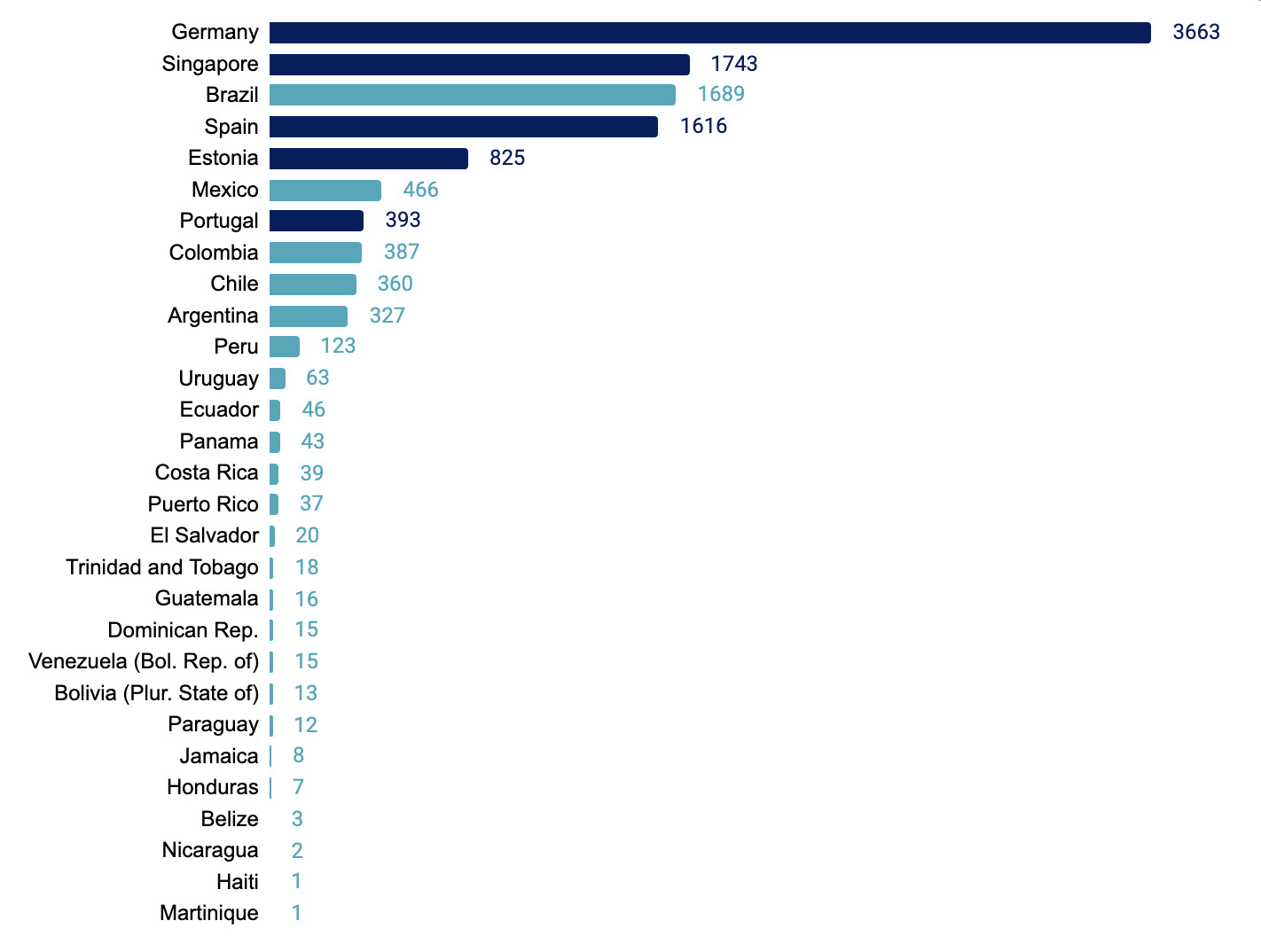
AI companies in Latin America and the Caribbean and selected countries, 2026
Source: Author’s own elaboration based on Crunchbase data.
AI-related business activity is highly concentrated geographically. Brazil accounts for 1,689 companies, equivalent to 45.5% of the regional total registered in Crunchbase. It is followed by Mexico, with 466 companies; Colombia, with 387; Chile, with 360; and Argentina, with 327. Together, these five countries account for approximately 87% of the AI companies in Latin America and the Caribbean included in the database.
Beyond this group, company numbers decline sharply. Peru records 123 companies, Uruguay 63, Ecuador 46, Panama 43 and Costa Rica 39, while the remaining countries and territories analysed have even fewer.
The size of the ecosystem, however, tells only part of the story. Countries with the largest number of companies are not necessarily those where AI-related companies account for the greatest share of businesses registered in the database.
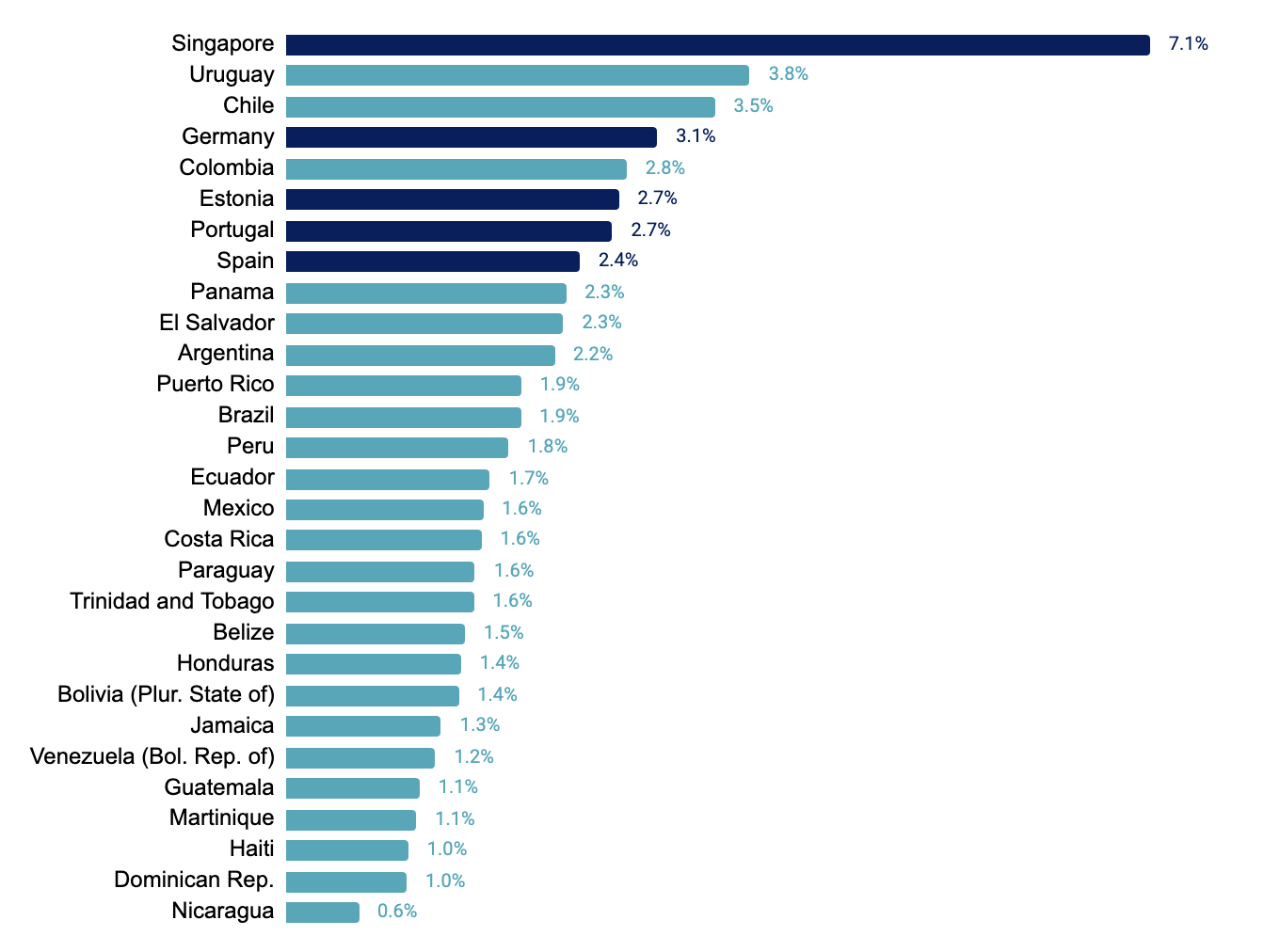
AI companies as a percentage of all companies registered in Crunchbase, 2026
Source: Author’s own elaboration based on Crunchbase data.
Considering AI-related companies as a share of all companies registered in Crunchbase in each country changes the regional picture somewhat. Among the Latin American and Caribbean countries represented, Uruguay records the highest share, at 3.8%, followed by Chile, at 3.5%. Colombia reaches 2.8%, while Panama and El Salvador each record approximately 2.3%, and Argentina 2.2%.
Brazil offers an important contrast. Although it accounts for almost half of the AI companies identified in the region, these represent approximately 1.9% of Brazilian companies registered in Crunchbase. Mexico records 1.6% and Peru 1.8%. This shows that the absolute size of the ecosystem and the relative prevalence of AI-related companies capture different dimensions: larger economies concentrate greater numbers of companies, while some smaller markets have a proportionally larger presence of AI-related businesses.
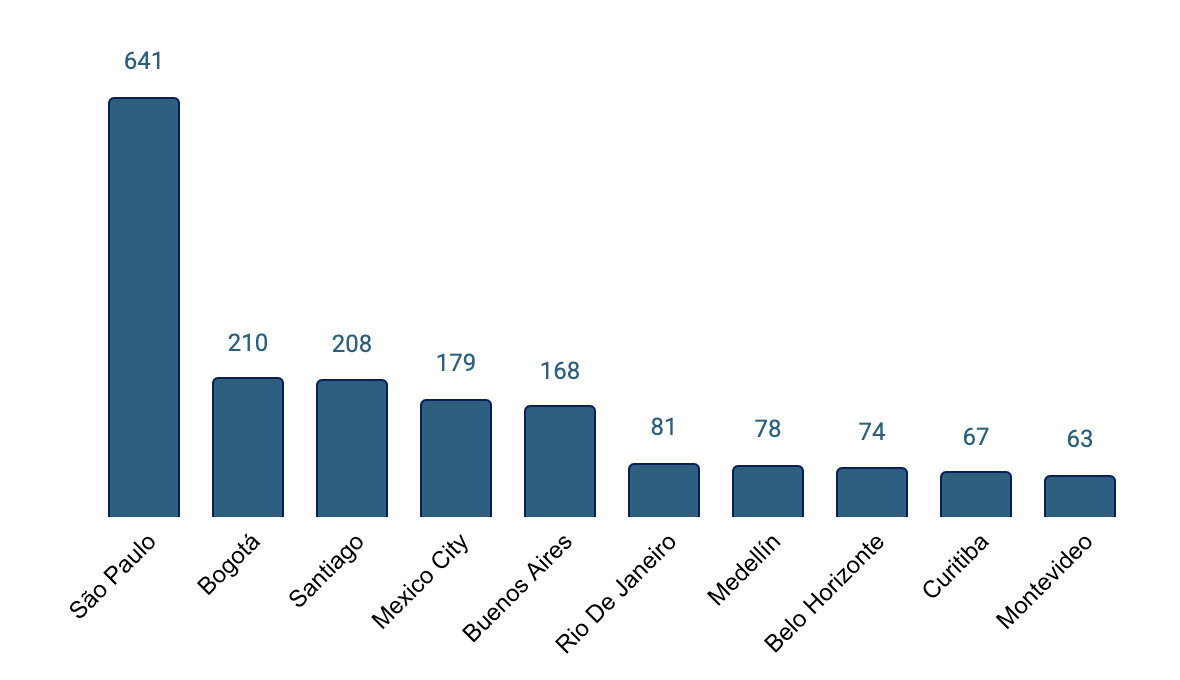
Concentration is also evident within countries. The database identifies 549 cities in Latin America and the Caribbean with at least one AI-related company, but a substantial share of companies is located in a few urban centres. São Paulo stands out with 641 companies, equivalent to 17.3% of the regional total. It is followed by Bogotá, with 210; Santiago, with 208; Mexico City, with 179; and Buenos Aires, with 168. A second group includes cities such as Rio de Janeiro, Medellín, Belo Horizonte, Curitiba, Montevideo, Florianópolis, Lima, Córdoba and Porto Alegre.
Leading Latin American cities by number of AI companies, 2026
Source: Author’s own elaboration based on Crunchbase data.
Taken together, the data reveal an AI business ecosystem that extends across much of the region but remains heavily concentrated in particular countries and urban hubs. At the same time, the higher relative shares observed in economies such as Uruguay and Chile show that a country’s size does not, on its own, determine the relative prominence of AI-related companies within its registered business base.
From the perspective of AI diffusion, this geography matters because an ecosystem of AI-related companies can support the development and adaptation of technologies, tools and solutions to specific productive and organizational needs. Strengthening these ecosystems beyond the main hubs could help broaden AI development and application capabilities across a more diverse range of countries and territories in the region.
Methodological note: The data cover companies active as of 30 May 2026, registered in Crunchbase and classified within the platform’s artificial intelligence industry group. Locations are assigned according to each company’s headquarters or head office. The percentage of AI companies is calculated against the total number of companies registered in Crunchbase in each country. It should therefore be interpreted as a measure of relative prevalence within this database, rather than the share of all businesses in the economy. Inclusion in the AI industry group does not, by itself, establish whether a company develops AI technologies or incorporates them into its products and services.
Más datos y hechos
Economía conectada
Economía digital
Lista de indicadores
ODS Relacionados
